

Treating Residual Chest Enlargement and Loose Skin in a 40-Year-Old Post-Bariatric Patient
A 40-year-old businessman from Hyderabad had lost 28 kilograms over eighteen months following bariatric surgery and had transformed his metabolic health entirely. His abdomen had reduced, his face had changed, but his chest had not followed. The rapid fat loss had made the residual glandular gynecomastia more visible than before, and the loose chest skin that had accompanied the weight loss added a further layer of deformity that no amount of continued weight reduction could address. Dr. Harikiran Chekuri at Redefine Clinic performed VASER-assisted liposuction combined with direct gland excision and minimal periareolar skin resection to complete the transformation his bariatric surgery had started, delivering a flat, well-contoured chest that finally matched the rest of his slimmer physique.
PATIENT PROFILE
| PARAMETER | DETAIL |
| Age | 40 years |
| Gender | Male |
| Occupation | Businessman |
| City | Hyderabad, India |
| Presenting Complaint | Residual bilateral chest enlargement and loose skin following 28 kg weight loss after bariatric surgery |
| Diagnosis | Post-bariatric gynecomastia with residual fatty and glandular component, mild chest skin laxity |
| Pre-Bariatric Weight | 108 kg (Height: 172 cm, BMI 36.5) |
| Current Weight | 80 kg (BMI 27.1). Weight stable for 10 months. |
| Time Since Bariatric Surgery | 18 months |
| Type of Bariatric Procedure | Laparoscopic sleeve gastrectomy |
| Hormonal Panel | Testosterone, LH, FSH, estradiol, prolactin all within normal range |
| Previous Gynecomastia Treatments | None. Condition was present before bariatric surgery but worsened in visibility post-weight loss. |
| Date of Surgery | March 2026 |
| Outcome | Good |
THE PROBLEM
The bariatric surgery had done exactly what it was supposed to do. Twenty-eight kilograms gone over eighteen months. His blood sugar normalised. His blood pressure came down. His sleep improved. He had a new relationship with food and a level of physical confidence he had not had in his thirties. But the chest was the one part of his body that refused to cooperate. It had been there before the surgery. Now, with the surrounding fat gone, it sat more prominently than ever.
The loose skin made it worse. The deflation that followed rapid weight loss had left the chest skin lax, with the breast tissue sitting lower than it used to. Even in a fitted shirt the chest looked wrong. He had worn compression undergarments daily since week twelve of his post-bariatric recovery. They helped marginally. They were not a solution. His bariatric surgeon had told him at the outset that weight loss alone would not fix true glandular gynecomastia, and that a plastic surgeon would need to address it separately once his weight had stabilised.
His weight had been stable for ten months. He started researching gynecomastia surgery in Hyderabad and consulted Dr. Harikiran Chekuri at Redefine to understand what the surgery would involve and what result was realistic for his specific post-bariatric chest presentation.
CONSULTATION & TREATMENT PLAN
WHAT WAS ASSESSED DURING THE CONSULTATION
A comprehensive physical and clinical evaluation was conducted before any surgical plan was finalised:
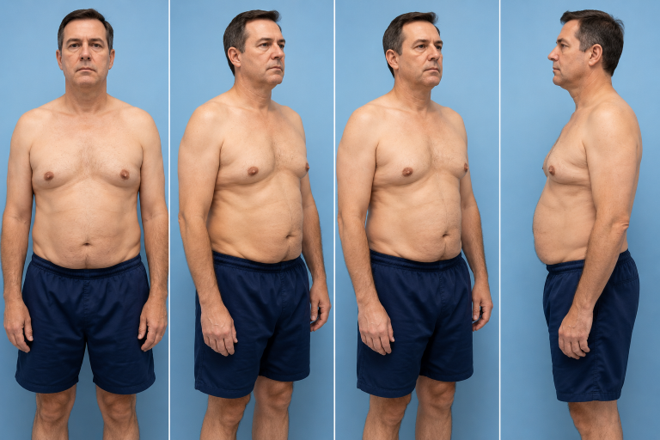
- Chest assessment: bilateral residual gynecomastia confirmed. Moderate fatty component surrounding a firm central glandular disc on each side. Mild but present skin laxity at the inferior chest border with a small degree of skin overhang over the pectoral fold.
- Skin elasticity: reduced compared to a standard gynecomastia patient of the same age, consistent with post-bariatric rapid weight loss. VASER technique selected in part for its superior skin retraction effect.
- Weight stability confirmed: 10 months at current weight. Essential prerequisite for post-bariatric body contouring. Further weight fluctuation would compromise the surgical result.
- Nutritional status reviewed: protein intake, vitamin D, B12, iron, and zinc levels assessed and confirmed adequate. Nutritional deficiency is a surgical risk factor in post-bariatric patients and was excluded before clearance.
- Hormonal panel: testosterone, oestradiol, prolactin, LH, and FSH all within normal range. Elevated oestradiol relative to testosterone is a known contributor to gynecomastia in previously obese patients and was factored into the surgical plan.
- Anaesthetic fitness: ECG, full blood count, metabolic panel reviewed. Cleared for general anaesthesia.
- Patient goals confirmed: flat masculine chest contour, elimination of glandular tissue, improvement of skin laxity to the extent possible without large visible scarring, result that completes the post-bariatric transformation.
WHY VASER LIPOSUCTION WITH GLAND EXCISION WAS CHOSEN
- Residual fatty component required liposuction before gland access. VASER ultrasound energy chosen over traditional liposuction for its superior skin retraction effect, directly relevant to the post-bariatric skin laxity present in this case.
- Gland excision necessary as the central fibrous glandular tissue cannot be aspirated by any liposuction technique regardless of energy modality
- Minimal periareolar skin resection planned to address the mild inferior skin overhang at the chest fold without creating a visible scar outside the areolar border
- VASER heat energy produces measurable dermal tightening in the weeks following surgery, partially compensating for reduced skin elasticity from rapid weight loss
- Combined approach in a single session avoids staged procedures and a second general anaesthetic
- Compression garment protocol extended beyond the standard duration to support skin retraction in a post-bariatric patient
PRE-OPERATIVE PHOTOS
Baseline photographs were taken from the front, both oblique angles, and lateral view to document the residual chest enlargement, skin laxity, and overall chest contour prior to surgery.
PROCEDURE FACTS
| PARAMETER | DETAIL |
| Procedure | VASER Liposuction + Gland Excision + Minimal Periareolar Skin Resection |
| Duration | Approximately 2.5 hours |
| Anaesthesia | General anaesthesia |
| Technology | VASER (Vibration Amplification of Sound Energy at Resonance) |
| Fat Aspirated | Approximately 350ml each side (700ml total) |
| Gland Weight | Approximately 32 grams right, 35 grams left |
| Skin Resection | Minimal periareolar, both sides. Scar within areolar border. |
| Drains | Bilateral. Removed at 48 hours. |
| Hospital Stay | Overnight observation. Discharged following morning. |
| Complications | None |
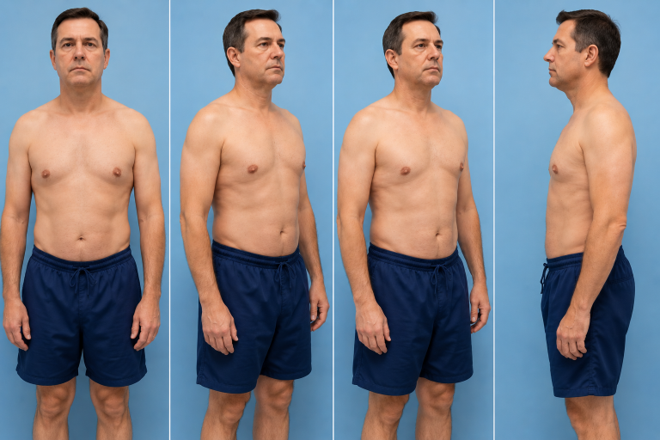
POST-OPERATIVE RESULTS
OUTCOMES AT A GLANCE
| OUTCOME METRIC | RESULT |
| Chest Contour | Flat and masculine. Residual enlargement fully resolved. |
| Glandular Tissue | Completely excised bilaterally. Confirmed by intraoperative palpation. |
| Skin Laxity | Significantly improved. VASER retraction continued progressively to 3 months. |
| Lateral Chest Wall | Smooth contour. Transition from chest to flank is well-defined. |
| Scar Visibility | Scars within the periareolar border. Fading well at 4-month review. |
| Symmetry | Excellent bilateral symmetry achieved. |
| Compression Garment | Discontinued at 8 weeks. Earlier than the patient had expected. |
| Complications | None |
| Patient Satisfaction | Good |
PATIENT FEEDBACK
Feedback recorded at the 4-month follow-up visit at Redefine, Hyderabad.
Google Review
★ ★ ★ ★ ★ 5.0
Verified Patient (Name withheld for privacy)
“I lost 28 kilos after my sleeve surgery. Everything changed except the chest. My bariatric surgeon had told me from the beginning that surgery would not fix the chest tissue and that I would need to see a plastic surgeon separately once my weight was stable. I waited until I was stable for almost a year, then came to Redefine. Dr. Harikiran explained the VASER approach and the skin tightening effect that comes with it. The recovery was straightforward. I wore the compression garment for two months and by the time I came off it the chest was completely flat. At four months I look like the transformation I set out to achieve is finally complete. The chest used to be the one thing that was holding the result back. It is not anymore.”
POST-OPERATIVE CARE & RECOVERY
- Wear compression garment continuously for eight weeks given post-bariatric skin laxity. Transition to daytime wear only from week nine through week twelve.
- Drain care at home following discharge. Record drain output twice daily. Drains removed at the 48-hour review when output falls below threshold.
- Take prescribed antibiotics and oral analgesics as directed. Report any increase in pain, swelling, or warmth at the surgical sites.
- No raising arms above shoulder height for two weeks. No carrying, pushing, or lifting anything heavy for three weeks.
- Light walking from day three. No cardiovascular exercise, gym work, or upper body activity for six weeks.
- Maintain current weight throughout the recovery period. Further significant weight loss or gain will alter the surgical result.
- Scar massage with silicone gel to begin at four weeks once wounds are fully closed.
- Nutritional status to be maintained at post-bariatric recommended levels throughout recovery. Adequate protein intake supports wound healing.
- Follow-up reviews at 48 hours, two weeks, six weeks, three months, and four months.
RECOVERY TIMELINE
| TIMEFRAME | WHAT TO EXPECT |
| Day 1 to 2 | Drains in place. Compression garment applied. Rest at home. Mild to moderate chest tightness and swelling. |
| Day 3 to 7 | Drains removed at 48-hour review. Bruising visible. Light activity within the home permitted. |
| Week 2 to 3 | Bruising fading. Swelling reducing. Two-week wound review. Can resume desk work. |
| Week 4 to 6 | VASER skin retraction progressing. Chest contour improving week on week. Compression garment continues. |
| Week 8 | Compression garment discontinued. Near-final chest contour visible. Light lower body exercise permitted. |
| Month 3 to 4 | VASER-induced tightening complete. Final result confirmed. Scars fading within periareolar border. |
DISCLAIMER
This case study is for informational purposes only and does not constitute medical advice. Post-bariatric body contouring carries specific considerations including nutritional status, skin elasticity, and weight stability that differ from standard gynecomastia surgery. Individual results may vary based on the degree of weight loss, skin laxity, residual glandular tissue, and individual healing response. A minimum of twelve months of weight stability is typically recommended before post-bariatric body contouring procedures. Consult a qualified plastic surgeon to understand what is achievable for your specific post-bariatric presentation. Patient identity withheld per confidentiality guidelines. Feedback published with written consent.
Dr. Harikiran Chekuri
MBBS, MD, MCh (Plastic Surgery)
Redefine Hair Transplant & Plastic Surgery Centre, Hyderabad
redefineu.in | +91 92371 23456