Dimple creation is a short procedure done under local anaesthesia, performed from inside the mouth, so it leaves no scar on the face. This blog explains each stage of the surgery, how the dimple settles over the first four weeks, and how long the result lasts. It also covers the real risks and why placement at the marking stage decides whether the dimple looks natural.
Dimples are caused by a small variation in the cheek muscle. Surgery recreates that variation deliberately. The procedure takes under thirty minutes per side, is done under local anaesthesia, and leaves no mark on the outside of the face. Yes, and the result, when placement is correct, is indistinguishable from a natural dimple once the healing phase has passed.
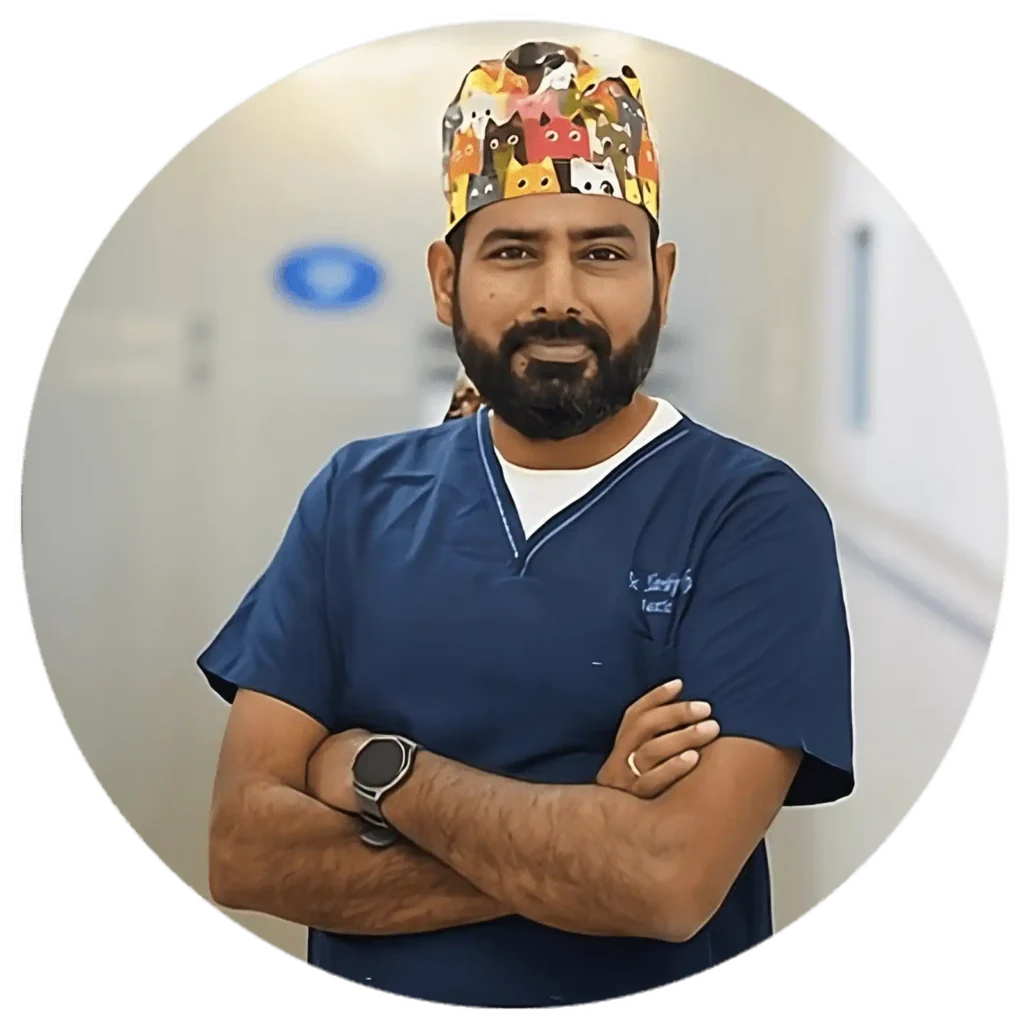
According to Dr Harikiran Chekuri, one of India’s pioneering plastic surgeons, “Dimple creation surgery is not about making a dimple; it is about making a dimple that looks like it was always there. Placement, depth, and suture technique work together as one plan. When they do, the dimple shows only when the patient smiles, exactly as a natural one would. Patients whose surgery gets any one of these wrong are the ones who come back wondering why the dimple stays visible at rest. The result looked done because the technique never matched how a natural dimple moves.”
What Does the Procedure Involve at Each Stage?
The entire procedure is performed from inside the mouth the outer face is marked before surgery begins, but no incision is ever made there.
- Marking: Position is mapped on the outer cheek with the patient seated and actively smiling, because the correct location depends on how that individual’s face moves a fixed measurement produces placement that can look off on certain face shapes
- Anaesthesia: An injection of local anaesthetic into the inner cheek is all that is required; the patient stays awake, there is no recovery room, and discharge happens the same day
- Tissue modification: A small opening on the inner cheek lining allows the surgeon to modify roughly 3mm of muscle this is the step that creates the gap responsible for the dimple’s appearance on smiling
- Suture placement: One absorbable suture connects the cheek skin to the muscle fascia beneath it; no removal appointment is needed because it dissolves as the internal tissue heals around it
No external wound exists after the procedure. Both sides together take under an hour.
Facial implants address structural changes at the bone level for patients whose goals extend beyond soft tissue.
What Happens to the Dimple in the Weeks After Surgery?
The dimple is visible from the moment surgery ends — but for the first two to four weeks it shows even without smiling, which is normal and not the final result.
- Swelling: Cheek swelling peaks at day two or three; it is mild in most cases and comes down steadily without any specific treatment beyond standard medication
- Resting visibility: While the suture holds the skin depressed, the dimple stays visible at rest; this resolves once the suture dissolves and scar tissue takes over the tethering function, leaving a dimple that appears only on expression
- Eating: Hard or chewy food puts pressure on the healing inner lining, so soft foods for the first two to three days reduce discomfort and speed internal healing
- Daily routine: No dressing covers the face, no suture sits on the skin, and the inner incision is small enough that most patients are back at work the next day without anyone noticing they had a procedure
Four weeks is the typical point at which the resting visibility disappears completely.
Patients considering facial surgery alongside dimple creation should discuss how to coordinate recovery periods during the consultation stage, not after booking.
How Long Do the Results Last and What Are the Real Risks?
Once the suture dissolves, scar tissue takes over, and that scar tissue keeps the dimple in place long term.
- Duration: Results hold well in most patients. Some softening is possible with age, but outright loss is uncommon when the suture technique was sound.
- Risk level: Dimple creation sits inside the mouth with no skin break on the face, so surgical risk is low. Infection, asymmetry, and gradual fading are the outcomes worth discussing, and each depends on how the procedure was performed.
- Reversing it: Removal needs a second procedure to release the internal scar tissue. It is not a quick fix, so placement deserves careful thought beforehand.
- Medical clearance: Oral infection, active cheek inflammation, or a bleeding disorder need sign-off from a treating doctor first, because each changes how the internal tissue heals.
Complications in dimple creation are uncommon. When they occur, placement error at the marking stage is almost always the contributing factor.
Patients who also want better skin quality can read whether the PRP vampire facial works and what it can and cannot treat.
Key Takeaway: Dimple creation works through a single absorbable suture placed inside the mouth. The result lasts because scar tissue replaces the suture’s function over time. What determines whether it looks natural is not the suture itself it is where the surgeon placed the mark before the procedure began.
Frequently Asked Questions
Will the dimple look artificial?
If placement and depth are right, it appears only on a smile. The always-on visibility in the first few weeks is due to healing, not what you will be left with.
Can I have just one dimple done?
Yes. Matching a natural dimple on the other side is one of the more common reasons people book this procedure.
Does it leave a scar on the face?
No incision is made on the outside of the face. There is no external scar.
How long does the procedure take?
Under thirty minutes per side. Both cheeks in under an hour.
When can I eat normally?
Soft foods for two to three days. Most patients are back to normal eating within a week.
Can it be undone later?
Yes, but it requires surgery to release the scar tissue. It is not a simple reversal, which is why placement decisions deserve proper time at consultation.
Reference
- Chen A, Gerry D. The Dimpleplasty: A New Streamlined Approach to Surgical Creation of Dynamic Facial Dimples, Our Experience, and Results. https://journals.sagepub.com/doi/10.1177/0748806818814142
- New Landmarks for the Surgical Creation of Dimples Based on Facial Form. Journal of Clinical and Aesthetic Dermatology. 2018. https://pmc.ncbi.nlm.nih.gov/articles/PMC5955629
- Enticing Dimples: A Novel Observational Study Comparing the Preexisting Landmarks for Facial Dimple Creation Using 3D-Scanned Facial Images. Indian Journal of Plastic Surgery. 2025.
https://thieme-connect.de/products/ejournals/html/10.1055/s-0044-1801772