
Hair can be transplanted into scar tissue, but results are less predictable because scars have a weaker blood supply. This blog covers which scars are suitable, why the scar must be mature and stable, and how density is likely to differ from a normal recipient area. It also explains the role of test grafts and when alternatives such as scalp micropigmentation or scar revision are the better first step.
Scar tissue isn’t scalp tissue and that difference changes how the procedure is planned and what results are realistic. Normal scalp has blood supply, sebaceous glands, and tissue architecture that supports graft survival. Scar tissue has varying degrees of all three, depending on how the scar formed, how deep it goes, and how old it is. A clean surgical scar behaves very differently from a hypertrophic burn scar or a depressed traumatic injury. Graft survival in scar tissue is lower than in healthy scalp not low enough to rule out the procedure, but low enough that expectations need to be set before surgery, not after the first result.
According to Dr. Harikiran Chekuri, hair transplant surgeon in Hyderabad, “Scar hair transplantation is technically achievable in the right patient, but the scar has to be assessed properly first blood supply, tissue pliability, and scar maturity all determine whether grafts will survive, and operating on a scar that isn’t ready produces a poor result that’s hard to revise.”
What Makes Scar Tissue Different From Normal Scalp for a Hair Transplant?
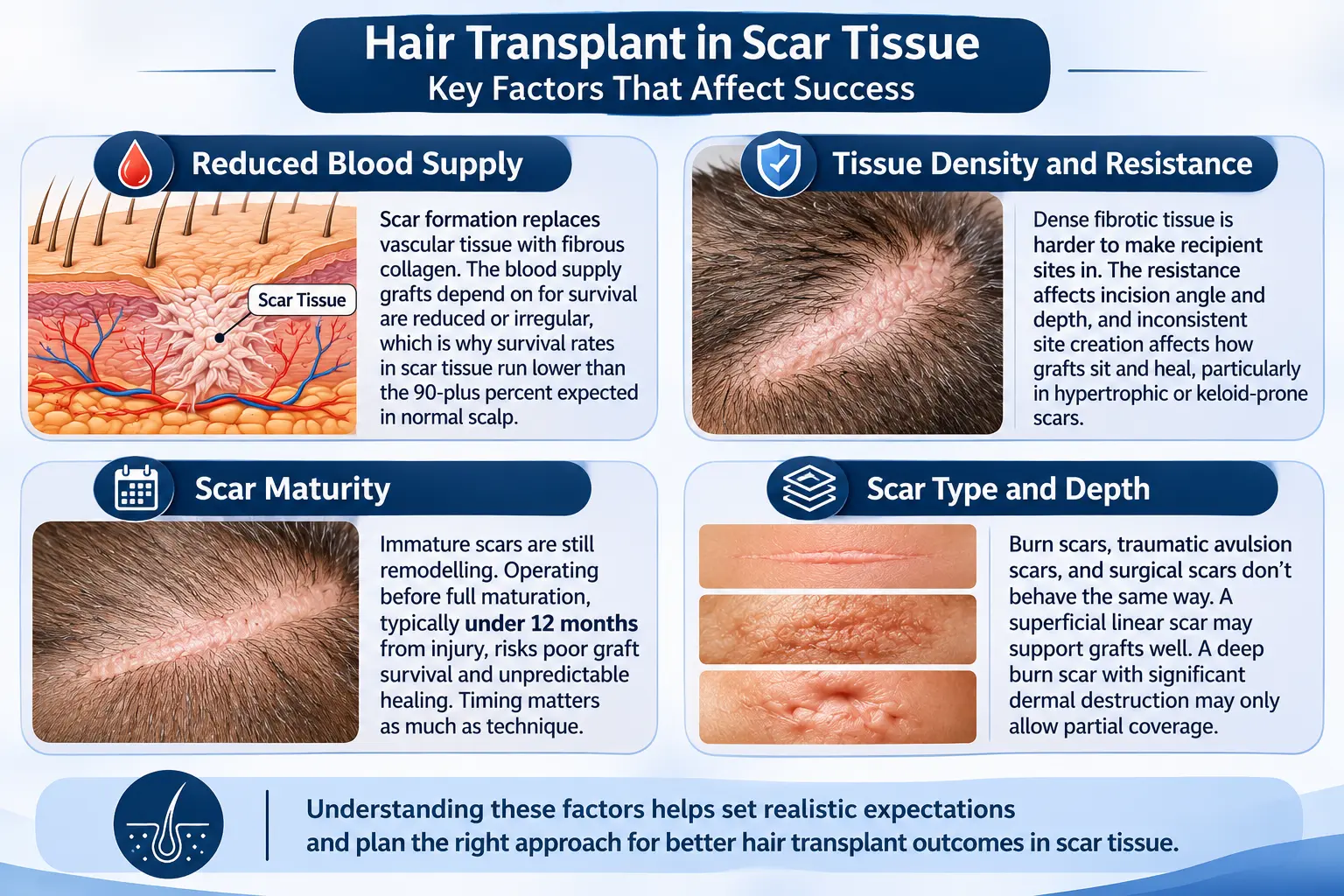
The pre-surgical scar assessment determines whether the procedure is appropriate, what density is realistic, and whether a test graft session makes more sense than a full procedure first. In scarring cases, FUE hair transplant is the preferred approach because precise, individual graft placement matters more here than in any standard procedure.
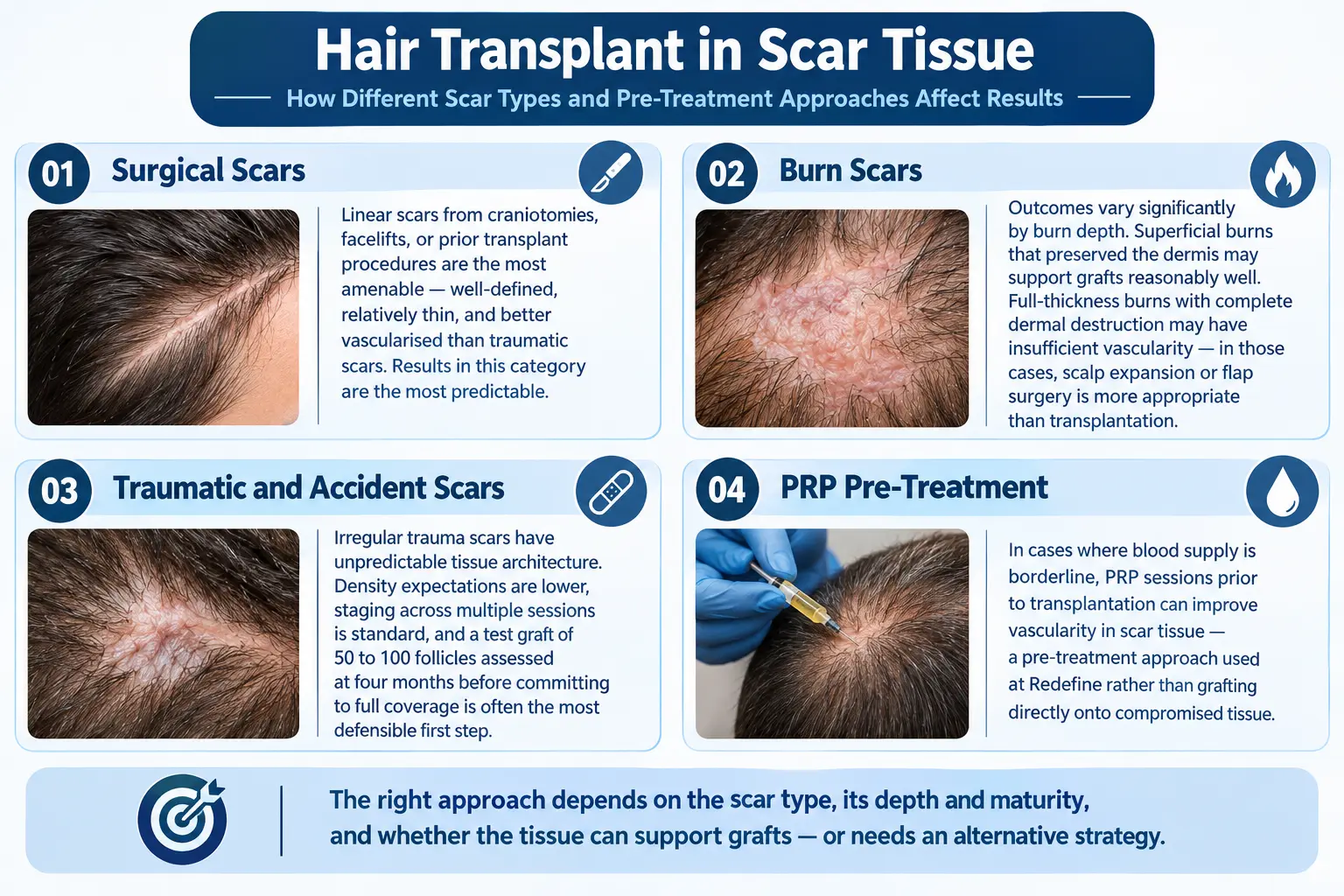
What Types of Scars Can Be Treated and What Results Are Realistic?
Achieving natural-looking coverage in a scar is a different goal from achieving density. Understanding the difference between FUE and DHI hair transplant techniques matters here the method selected directly affects how precisely grafts can be placed in tissue that doesn’t behave like normal scalp
What Determines the Right Treatment Approach?
Vascularity assessment: Dermoscopy and clinical palpation assess blood supply and tissue pliability before any planning. A soft, pliable scar with reasonable vascularity is a different surgical conversation from one that is indurated, hypopigmented, and poorly perfused.
Test graft session: Where vascularity is uncertain, implanting 50 to 100 grafts and reviewing survival at four months gives a reliable indication of what a full session will produce. It’s a longer process but it protects the patient from a full session on compromised tissue.
Staging across sessions: Scar tissue responds to grafting differently from normal scalp. The first session creates micro-trauma that can improve local vascularity; second-session survival rates in previously grafted scar tissue are often better than the first. Staging is a deliberate strategy, not just a workaround for lower density.
Scalp expansion or flap surgery: Where scar tissue is too extensive or poorly vascularised for transplantation, scalp expansion and rotation flap techniques bring normal hair-bearing scalp into the scarred area. The more appropriate option when the tissue can’t support grafts at a clinically meaningful density.
The right approach depends entirely on what the scar assessment shows. A scar that looks like a hair transplant case on the surface sometimes isn’t once the tissue is examined properly.
Frequently Asked Questions
How long after an injury should I wait before a scar hair transplant?
Minimum 12 months from injury scar tissue needs to fully mature before grafting, and operating before that produces unpredictable results.
Will hair grow normally in scar tissue after a transplant?
Growth is achievable but density is typically lower than in normal scalp, coverage rather than full density is the realistic goal in most scar cases.
Is a test graft always necessary before a full scar transplant?
Not always. Well-vascularised surgical scars with pliable tissue may not need one, but traumatic or burn scars with uncertain blood supply usually benefit from a test session first.
Can keloid scars be treated with hair transplantation?
Keloid-prone patients are high risk for scar transplantation the procedure itself can trigger further keloid formation, and this needs to be assessed and discussed before any surgical planning.
Reference
- Ekelem C, et al. (2019). Hair transplantation outcomes in scarring alopecia a systematic review. Skin Appendage Disorders, PubMed Central (PMC), National Institutes of Health.
- Shin JW, et al. (2019). FUE hair transplantation on postsurgical scar tissue graft survival and clinical outcomes. BioMed Research International, PubMed Central (PMC), National Institutes of Health.
- Suresh R, et al. (2019). Hair transplantation on burn and traumatic scar tissue using PRP to improve graft survival. International Journal of Trichology, PubMed Central (PMC), National Institutes of Health.