

A Longevity Protocol Case from Hyderabad: 38-Year-Old Corporate Executive
A 38-year-old senior manager from Hyderabad presented with persistent fatigue, declining energy, and poor post-exercise recovery that had worsened progressively over two years despite unremarkable routine blood work. Conventional medicine offered no actionable findings. He was not ill by standard measures but he was not functioning at the level his work and lifestyle demanded. Dr. Harikiran Chekuri at Redefine Clinic evaluated him under the Longevity and Preventive Health framework and designed a personalised peptide protocol addressing systemic repair, immune modulation, and natural growth hormone support. After twelve weeks on protocol, the patient reported significantly improved energy, faster exercise recovery, and measurably sharper cognitive performance under workload.
PATIENT PROFILE
PARAMETER | DETAIL |
Age | 38 years |
Gender | Male |
Occupation | Senior Manager, IT sector |
City | Hyderabad, India |
Presenting Complaint | Chronic fatigue, persistent low energy, poor post-exercise recovery, reduced mental sharpness |
Duration of Symptoms | Progressive decline over 24 months |
Routine Blood Work | All parameters within normal range |
Sleep Duration | 7 to 8 hours reported but non-restorative |
Exercise Frequency | 3 to 4 sessions per week, recovery taking longer than previously |
Alcohol | Occasional, less than 2 units per week |
Smoking | Non-smoker |
Previous Interventions | Vitamin B12, Vitamin D, ashwagandha supplementation. Minimal improvement. |
Date of Protocol | February to May 2026 |
Outcome | Good |
THE PROBLEM
He was 38, slept seven to eight hours a night, exercised regularly, and ate reasonably well. By every conventional health measure, nothing was wrong. But something had shifted. The energy he used to bring into a Monday morning had stopped showing up. He would finish a workout that two years earlier would have left him feeling strong, and instead spend the rest of the day trying to recover. Afternoons at the office required effort that used to feel automatic.
He had gone through the standard investigation route. Full blood count, thyroid panel, vitamin levels, liver function. Everything came back normal. His GP reassured him. His cardiologist found nothing concerning. He was told he was healthy and perhaps just stressed. He cut his workload for three months and found no change. He tried B12 injections, high-dose vitamin D, and an ashwagandha protocol from a wellness brand. None of it moved the needle in any meaningful way.
He came across peptide therapy in Hyderabad while researching longevity protocols and booked a consultation with Dr. Harikiran Chekuri at Redefine. He was not looking for a quick fix. He wanted a structured, evidence-informed approach to rebuilding his baseline.
CONSULTATION & TREATMENT PLAN
WHAT WAS ASSESSED DURING THE CONSULTATION
A comprehensive longevity-focused evaluation was conducted before the protocol was designed:
- Symptom timeline reviewed: fatigue onset, pattern of decline, sleep quality, exercise recovery, cognitive performance under high workload
- Routine investigations reviewed: all within normal range. No endocrine, haematological, or metabolic pathology identified
- Advanced biomarker panel requested: IGF-1, cortisol diurnal rhythm, testosterone, DHEA-S, hsCRP, ferritin, homocysteine, fasting insulin
- IGF-1 finding: IGF-1 at lower end of normal range for age, consistent with suboptimal natural growth hormone secretion and impaired tissue repair signalling
- hsCRP mildly elevated:1 mg/L, indicating low-grade systemic inflammation not flagged on routine testing
- Sleep quality assessment: non-restorative sleep despite adequate duration, consistent with impaired recovery signalling
- Patient goals confirmed: improved sustained energy, faster exercise recovery, sharper cognitive performance, no pharmaceutical intervention
WHY PEPTIDE THERAPY WAS CHOSEN
- Peptides operate at the signalling level, addressing the underlying recovery and repair deficits rather than masking symptoms
- BPC-157 selected for its role in systemic tissue repair, gut-brain axis modulation, and reduction of low-grade inflammatory load
- Thymosin Alpha-1 selected for immune modulation and restoration of immune surveillance function associated with chronic fatigue states
- CJC-1295 with Ipamorelin selected as a growth hormone secretagogue combination to restore natural GH pulse amplitude without suppressing the pituitary axis
- Approach avoids pharmaceutical hormone replacement and carries no dependency or shutdown risk
- Protocol designed in phases to assess response before advancing dosage, with biomarker re-evaluation at six and twelve weeks
- No downtime. No disruption to work or exercise schedule
PRE-TREATMENT ASSESSMENT
Baseline photographs were not applicable for this protocol. A full baseline biomarker panel and subjective symptom scoring across four domains was recorded before commencement to allow objective comparison at six and twelve weeks.
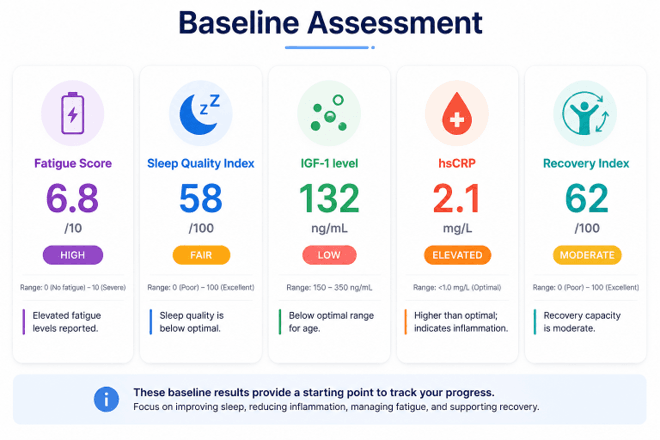
Baseline assessment: Fatigue Score | Sleep Quality Index | IGF-1 level | hsCRP | Recovery Index
TREATMENT DETAILS
- Initial consultation completed and advanced biomarker panel reviewed. Protocol designed based on IGF-1, hsCRP, and symptom profile
- Phase 1 commenced at week one. BPC-157 administered subcutaneously at 250mcg once daily, five days on two days off
- Thymosin Alpha-1 administered subcutaneously at 1.5mg twice weekly for the first six weeks
- CJC-1295 with Ipamorelin administered subcutaneously at 100mcg each, combined in a single injection, five nights per week at bedtime to align with the natural GH pulse
- Patient trained in self-administration technique at the first session. Injection sites rotated between abdomen and thigh
- Six-week interim review conducted. Biomarkers rechecked. IGF-1 had risen within optimal range. hsCRP had reduced to 0.9 mg/L. Patient reported early improvement in sleep quality and exercise recovery
- Phase 2 dosage adjustments made based on six-week response. BPC-157 continued. Thymosin Alpha-1 reduced to once weekly maintenance dose
- Twelve-week final review completed. Full biomarker panel repeated. Subjective symptom scoring recorded across all four domains
TREATMENT FACTS
| PARAMETER | DETAIL |
| Treatment Type | Personalised Longevity Peptide Protocol |
| Peptides Used | BPC-157, Thymosin Alpha-1, CJC-1295, Ipamorelin |
| Protocol Duration | 12 weeks (February to May 2026) |
| Administration Route | Subcutaneous injection, self-administered |
| Session Frequency | Daily to 5 nights per week depending on peptide |
| Phase Reviews | Biomarker review at 6 weeks and 12 weeks |
| Pharmaceutical Drugs | None prescribed |
| Downtime | None |
| Complications | None. Mild transient injection site redness in week one only |
POST-TREATMENT RESULTS
The response was gradual and progressive. The first meaningful change the patient noted was sleep quality at week four. He was waking less through the night and described mornings as feeling different, more rested than he had been in two years. Exercise recovery improved between weeks six and eight. Workouts that had been leaving him flat for the rest of the day were no longer doing so. By week ten, his energy levels through the afternoon had stabilised. The cognitive improvement was the last to arrive and the most significant to him professionally. He described his capacity to stay present and analytical through back-to-back meetings as returning to where it had been two years earlier. At the twelve-week review, all four subjective scoring domains had improved. IGF-1 sat within the optimal range for his age. hsCRP had normalised at 0.9 mg/L from a baseline of 2.1 mg/L.
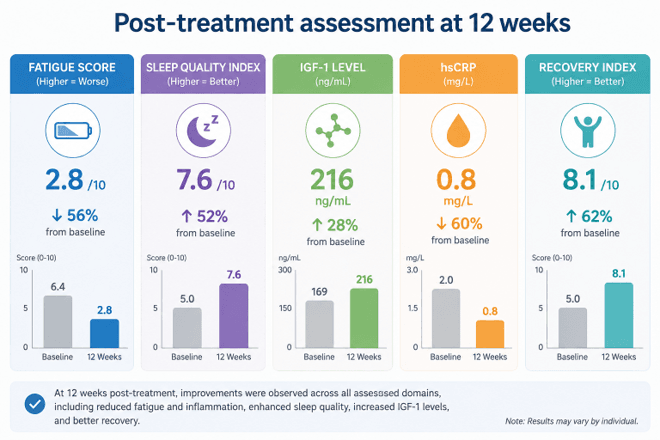
Post-treatment assessment at 12 weeks: Fatigue Score | Sleep Quality Index | IGF-1 level | hsCRP | Recovery Index
OUTCOMES AT A GLANCE
| OUTCOME METRIC | RESULT |
| Sustained Energy | Significantly improved. Afternoon crashes resolved by week ten |
| Sleep Quality | Noticeably improved from week four. Non-restorative sleep resolved |
| Exercise Recovery | Faster from week six. Post-workout fatigue duration reduced by patient estimate of 60 percent |
| Cognitive Performance | Improved focus and mental endurance under high workload confirmed by week ten |
| IGF-1 | Moved from lower normal range to optimal range for age at 12-week review |
| hsCRP | Reduced from 2.1 mg/L at baseline to 0.9 mg/L at 12 weeks |
| Pharmaceutical Intervention | None required |
| Complications | None |
| Patient Satisfaction | Good |
PATIENT FEEDBACK
Feedback recorded at the 12-week review visit at Redefine, Hyderabad.
Google Review ★★★★★ 5.0
Verified Patient (Name withheld for privacy)
“I have been dealing with this for almost two years before I came to Redefine. Everything checked out fine on routine tests. My doctor said I was healthy. But I was exhausted all the time, struggling through workouts I used to handle easily, and mentally not as sharp as I needed to be. The peptide protocol changed that. By week six I was sleeping better. By week ten my energy levels had shifted noticeably. My recovery from exercise improved first, then my focus at work. At twelve weeks, the difference was significant enough that my team noticed I was more present in meetings. I wish I had done this two years ago instead of assuming it was just stress.”
POST-TREATMENT CARE & RECOVERY
Injection sites to be rotated consistently across abdomen and thigh to prevent localised tissue changes
Store peptide vials as directed. Reconstituted peptides to be refrigerated and used within the stated window
Maintain regular sleep schedule with consistent bedtime to support the natural GH pulse aligned with evening Ipamorelin dosing
Continue resistance training and aerobic exercise as part of the protocol. Physical stimulus supports the peptide signalling effect
Avoid high alcohol consumption throughout the protocol period as this suppresses natural GH secretion
No dietary restriction required beyond standard nutritional adequacy
Biomarker review scheduled at six weeks and twelve weeks to assess response and adjust dosing
Maintenance protocol discussed at twelve-week review based on individual response and patient preference
Any injection site reactions, unusual fatigue, or unexpected symptoms to be reported immediately
RESPONSE TIMELINE
TIMEFRAME | WHAT TO EXPECT |
Week 1 to 2 | Protocol established. Mild injection site redness possible in first week. No systemic effects expected yet. |
Week 3 to 4 | First subjective improvements typically noted in sleep quality and morning readiness. |
Week 5 to 6 | Exercise recovery begins to improve. Six-week biomarker review conducted. Dosage adjusted if indicated. |
Week 7 to 8 | Energy levels stabilising. Post-workout fatigue reducing. Cognitive improvements beginning. |
Week 9 to 10 | Sustained energy and mental performance improvements consolidating. Most patients report clear functional change. |
Week 12 | Final review. Full biomarker panel. Outcome scoring. Maintenance protocol discussed based on individual response. |