

Patients are told to avoid nicotine, alcohol, and vaping before surgery but rarely told why. Nicotine narrows blood vessels and reduces blood flow to healing tissue when the body needs it most. Alcohol interferes with how the body processes anaesthesia, making recovery longer and less predictable. Vaping irritates the airways that need to be managed during surgery. These aren’t background precautions they directly affect healing and surgical safety. Stopping two weeks before and resuming at discharge isn’t compliance. Healing continues well beyond discharge, and the same risks apply throughout.
According to Dr. Harikiran Chekuri, plastic surgeon in Hyderabad, “Smoking and vaping are among the most disruptive pre-operative factors we see. Nicotine causes vasoconstriction that reduces blood flow to surgical tissue at exactly the point when that tissue needs maximum supply. Patients who can’t stop four weeks out are asked to delay surgery, not because of preference, but because the complication rate doesn’t justify proceeding.”
What Does Each Substance Actually Do Before and After Surgery?
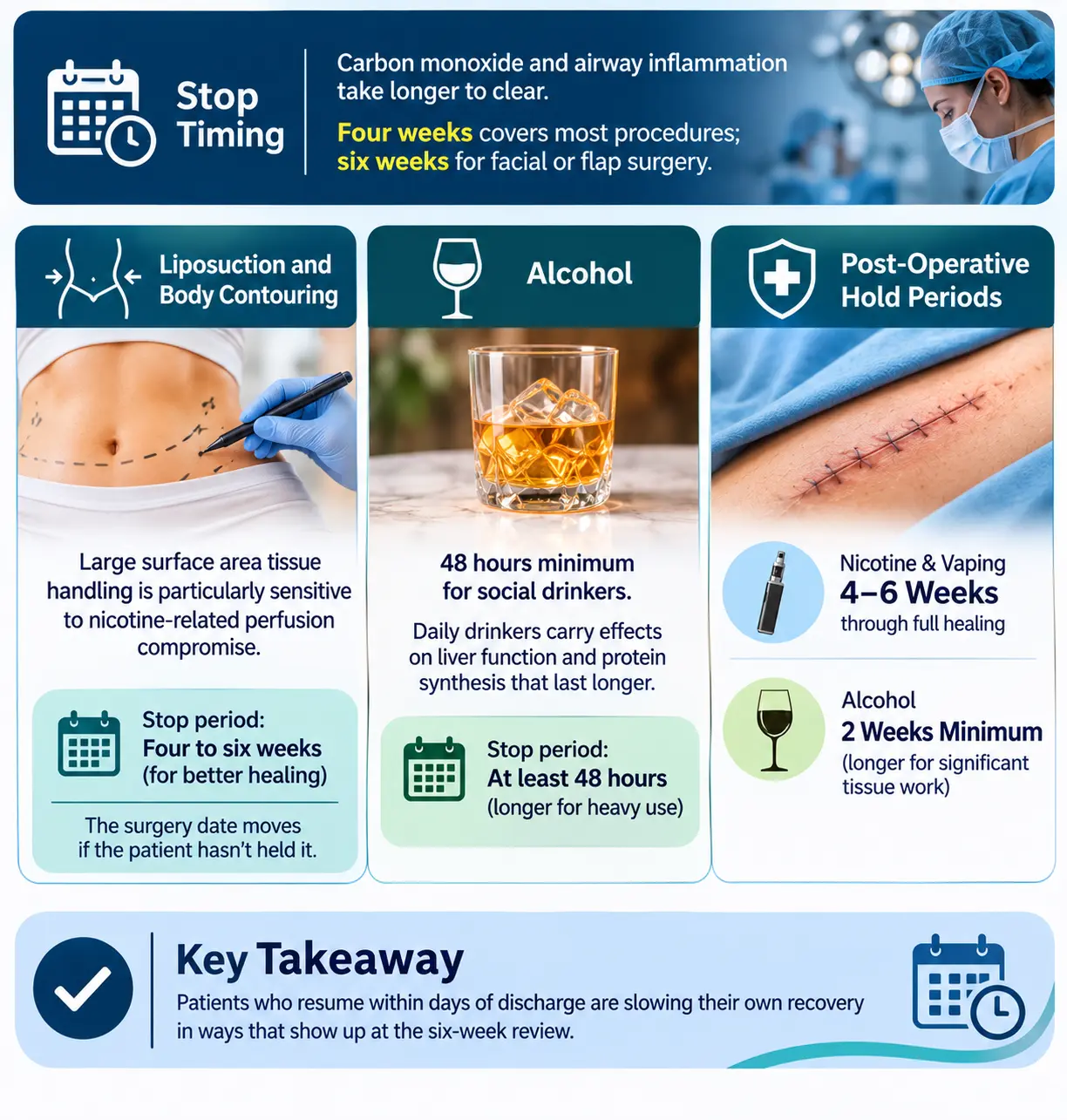
Stopping before surgery and holding through recovery aren’t the same instruction; most patients treat them as one. It’s a distinction that comes up consistently in procedures like rhinoplasty, where the recovery window is longer than most patients expect.
How Long Before and After Surgery Should You Actually Stop?
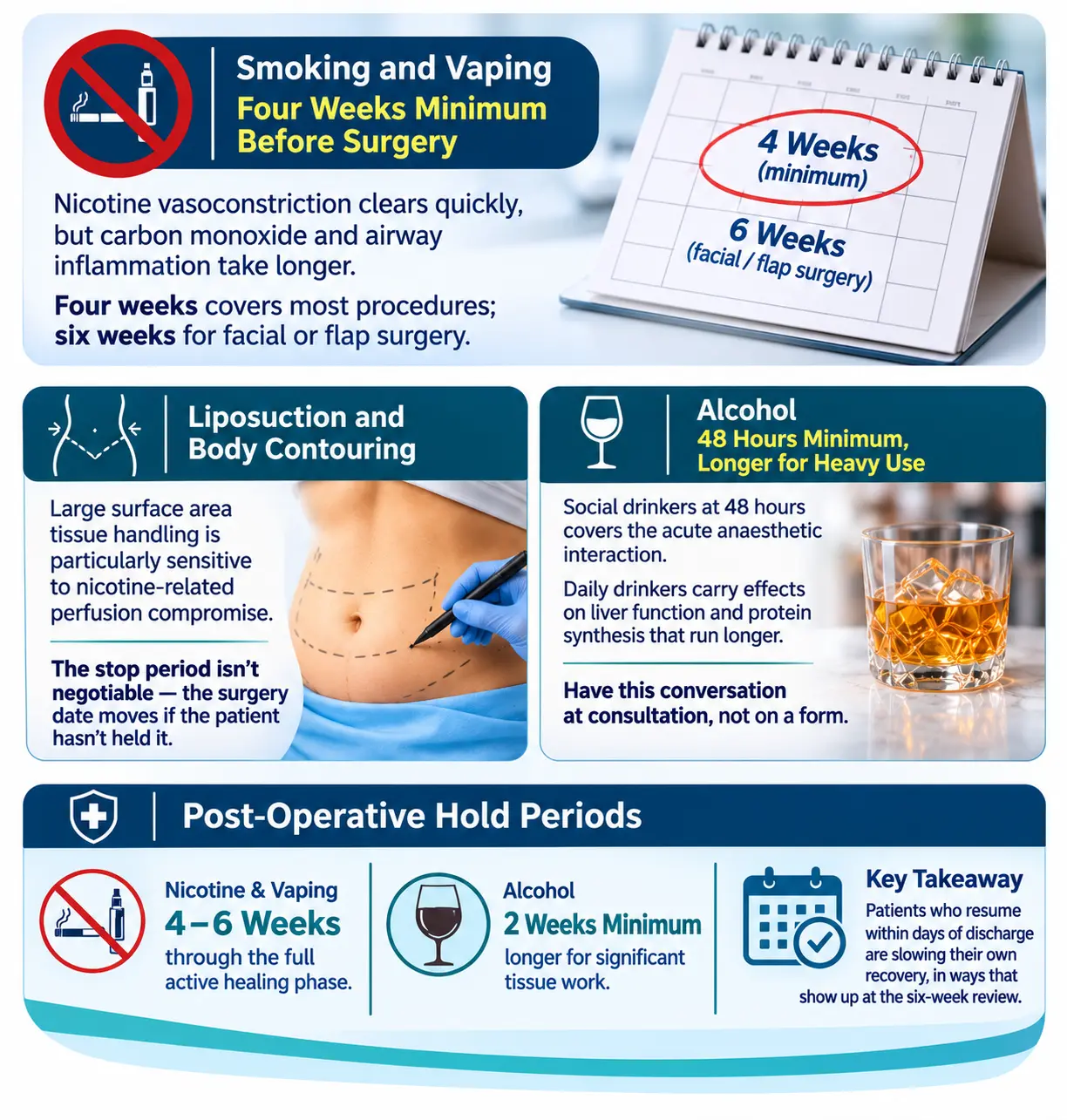
Whether your procedure tolerates early resumption depends on what was done and how much tissue was handled and for procedures involving substantial recovery, like those discussed in how long after pregnancy you can get a tummy tuck, that conversation belongs at the pre-op appointment, not after discharge.
What Determines the Right Treatment Approach?
Different procedures, different use patterns, different recovery timelines. The guidance isn’t the same for everyone, and treating it as a standard instruction misses most of what matters.
Pre-operative disclosure: Patients who underreport nicotine or alcohol use because they’re expecting judgment end up with anaesthetic and healing complications the surgical team wasn’t anticipating. Accurate reporting is clinical information, not a character assessment.
Procedure-specific risk: Nicotine sensitivity isn’t uniform across surgery types; facial procedures and anything with skin flap elevation carry higher sensitivity than minimally invasive interventions, and the stop timeline shifts accordingly rather than applying the same instruction across every patient.
Nicotine replacement during the stop period: Patches and gum still deliver nicotine and still cause vasoconstriction. Patients who switch from cigarettes to a patch and consider the pre-op requirement satisfied aren’t compliant, because the mechanism that creates surgical risk is the nicotine itself, not the combustion.
Post-operative monitoring: Wound healing complications from resumed nicotine or alcohol use don’t always present immediately; delayed wound breakdown and slow scar maturation can trace back to substance use in the recovery window, and the connection is difficult to make without asking directly at the follow-up.
The pre-operative conversation about this is worth more than the discharge paperwork. Most complications in this category were preventable at the consultation.
Frequently Asked Questions
Can I drink alcohol the night before surgery?
No alcohol within 24 hours changes how anaesthetic agents are metabolised and raises bleeding risk; even one drink the night before makes the anaesthetic picture less predictable.
Is vaping safer than smoking before surgery?
No nicotine delivery is equivalent, vasoconstriction runs the same, and vaping adds airway irritation that creates its own separate problem under anaesthesia.
How soon after surgery can I smoke again?
Four to six weeks minimum; new tissue is still establishing blood supply through that window, and nicotine keeps vessels narrow precisely when healing needs them open.
Does nicotine replacement count as stopping before surgery?
No, patches and gum still deliver nicotine and still cause vasoconstriction; the mechanism that makes smoking dangerous pre-operatively is the nicotine, not the smoke.
Reference
- Møller AM, et al. (2009). Perioperative smoking and alcohol cessation to reduce postoperative complications. British Journal of Anaesthesia, PubMed, National Library of Medicine.
- Sorensen LT. (2012). Wound healing and infection in smokers across surgical specialties. Archives of Surgery, PubMed, National Library of Medicine.
- Jian Z, et al. (2023). Smoking and postoperative wound complications across major surgical procedures. PubMed Central (PMC), National Institutes of Health.