Three treatments, three mechanisms, three different risk profiles for Indian skin. Which one is appropriate depends on PIH risk, Fitzpatrick type, and what is actually being treated not which sounds most advanced. This post breaks down how each works, what Indian skin needs to factor in, and how the decision gets made.
Darker skin does not respond to resurfacing treatments the way lighter phototypes do and the difference is not marginal. Most Indian patients sit at Fitzpatrick IV, V, or VI, not III, and that distinction matters more than most treatment guides acknowledge. Melanin-rich skin at these phototypes is more reactive to heat, acid, and physical trauma. The wrong treatment at the wrong depth triggers post-inflammatory hyperpigmentation that takes longer to resolve than the original concern.
The question is never which treatment is best overall. It is what is right for this skin, this concern, this depth.
According to Dr Harikiran Chekuri, a plastic surgeon in Hyderabad, “Chemical peel treatment is often where Indian patients start because it feels like a smaller commitment. That is not wrong. But the peel type and strength matter enormously in darker skin. A Jessner peel used correctly on a Fitzpatrick IV patient and an unguided TCA peel on the same patient are completely different clinical situations.”
What Is the Clinical Difference Between These Three Treatments?
All three resurface or remodel skin but the mechanism, depth, and risk profile are not interchangeable.
| Chemical Peel | Laser | Microneedling | |
| Mechanism | Chemical exfoliation via acid removing damaged skin layers | Selective photothermolysis heat targets chromophores in skin | Mechanical micro-injuries triggering collagen induction |
| Depth options | Superficial, medium, deep controlled by acid type and concentration | Ablative or non-ablative controlled by wavelength and energy | 0.5mm to 2.5mm controlled by needle length and passes |
| PIH risk for Indian skin | Moderate to high depends entirely on peel type and depth | High with ablative lasers; lower with non-ablative and fractional | Lowest of the three melanocytes are largely undisturbed |
| Downtime | Superficial: 3-5 days. Medium: 7-10 days. Deep: 2-4 weeks | Ablative: 1–2 weeks. Non-ablative: minimal | 24-48 hours of redness |
| Best for | Pigmentation, superficial acne scars, uneven tone | Deeper scars, vascular concerns, hair removal | Acne scars, fine lines, skin texture, open pores |
| Sessions needed | 4-6 for superficial; fewer for deeper | 3-5 for most concerns | 3-6 spaced 4 weeks apart |
| Indian skin suitability | Safe with correct peel selection | Requires wavelength selection specific to darker skin | Generally the safest option across all Fitzpatrick types |
Peels and microneedling get sequenced together in Indian patients more often than not; results that neither produces at a safe depth alone become achievable when they are run in the right order.
With lasers, the category itself is not the risk; the wavelength and settings matter. Acne treatment in darker skin requires careful laser selection. Q-switched Nd:YAG and fractional options are very different from full-field ablative CO2. Same treatment category, completely different outcomes in Fitzpatrick IV–VI.
Which Treatment Is Right for Which Skin Concern in Indian Patients?
Skin type narrows the field. The concern being treated is what makes the final call.
- Pigmentation and melasma: Start with superficial glycolic or lactic acid peels they lift the pigmented epidermal layer without the heat stimulus that makes laser risky here. Medium-depth peels are not off the table, but four to six weeks of hydroquinone or azelaic acid priming comes first. Always.
- Acne scarring: Dermaroller treatment is where this starts for Indian skin It stimulates dermal collagen production without directly disrupting melanocytes. Deeper atrophic scars may eventually get fractional laser, but that comes after skin assessment and preparation, not as the first-line approach.
- Open pores and texture: Peels work at the epidermal surface. Pore architecture sits below that. Microneedling reaches it. Collagen induction without PIH risk is what textural concerns in darker skin need, not more exfoliation.
- Tan, dullness, surface glow: Superficial glycolic or mandelic acid. Mandelic specifically has a larger molecular size slower penetration, more even spread across reactive darker skin than glycolic at the same concentration.
No single treatment covers everything. Effective plans in Indian patients almost always combine two or three options, run in sequence over months, not side by side.
For concerns that go beyond resurfacing into structural facial changes, anti-aging fillers and Botox addresses what resurfacing cannot touch.
What Determines the Right Treatment Approach?
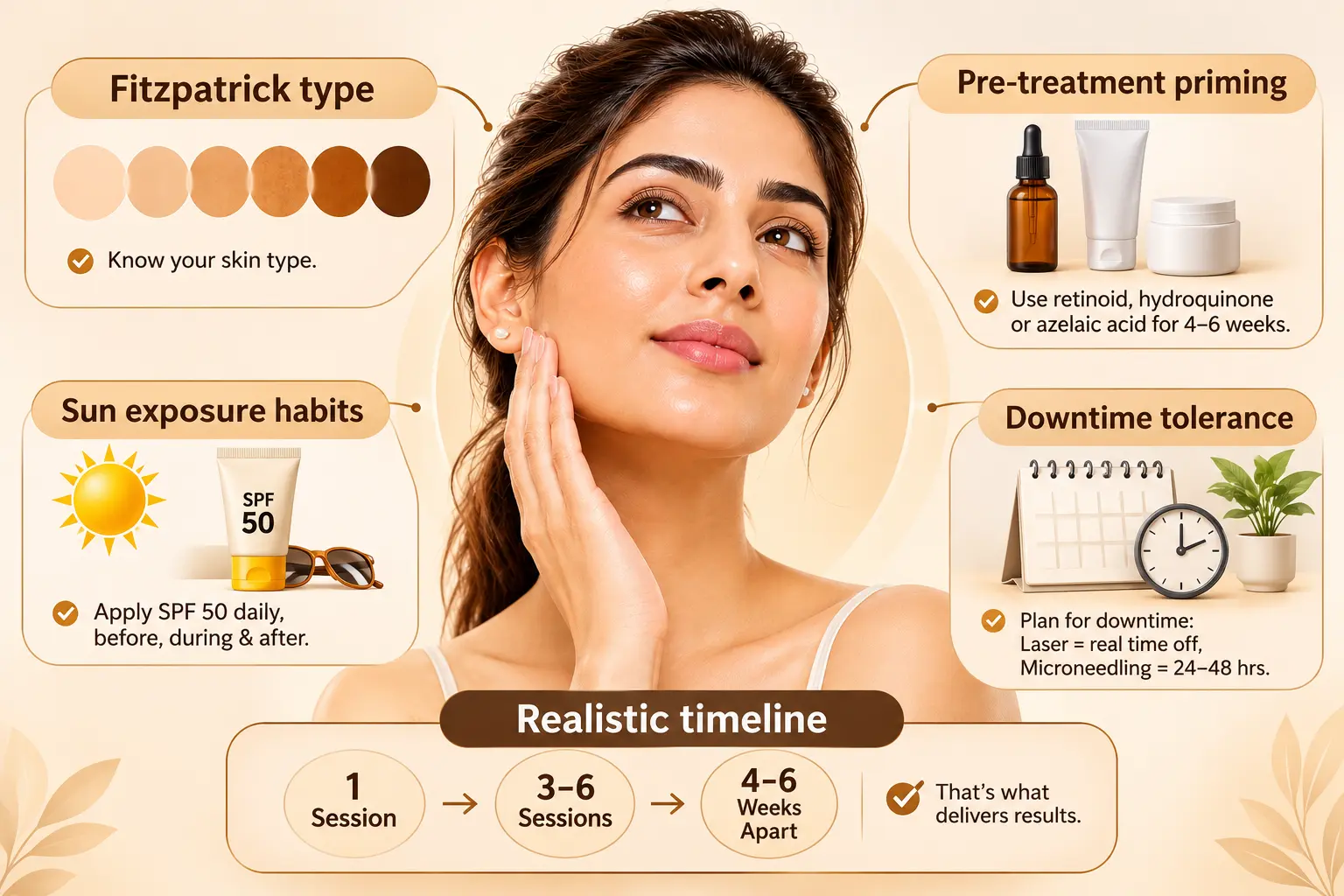
Six to nine months of consistent treatment and aftercare that is what final assessment of most Indian skin resurfacing results actually requires, the same patience that determines outcomes when choosing which chemical peel is best for skin whitening, where the full result only becomes visible after completing the full course.
Frequently Asked Questions
Is laser safe for Indian skin?
With correct wavelength selection, yes. Q-switched Nd:YAG and fractional non-ablative options carry far lower PIH risk than ablative CO2 in Fitzpatrick IV–VI skin. The laser type is what determines safety, not the category.
Which is better for acne scars in Indian skin?
Microneedling first stimulates dermal collagen, leaving melanocytes undisturbed. Deeper atrophic scars may eventually need fractional laser, but only after the skin has been properly assessed and prepared.
Can Indian skin have a chemical peel?
Yes. Superficial glycolic, lactic, and mandelic acid peels are well tolerated with the right priming and aftercare. Medium and deep peels need more caution and four to six weeks of skin preparation before anyone does anything.
How many sessions are needed to see results?
Three to six for most concerns, spaced four to six weeks apart. Six to nine months of consistent treatment before the result can be properly assessed.
What is PIH and why does it matter for Indian skin?
Post-inflammatory hyperpigmentation is darkening after skin trauma. Melanin-rich skin produces more melanin in response to any inflammatory stimulus, resurfacing treatments included. That is not a side effect risk. It is the central clinical factor that drives every treatment decision in darker skin.
Can all three treatments be combined?
Yes. Peels and microneedling together is common in Indian patients. Laser gets added after the skin’s response to the first two is known. Sequencing and spacing are what determine whether a combination works not just which treatments are chosen.
Reference
- Jain A, et al. A Comparative Study of the Efficacy of Chemical Peels and Microneedling in the Treatment of Moderate to Severe Melasma. PMC. 2025. https://pmc.ncbi.nlm.nih.gov/articles/PMC12790136/
- Al Qarqaz F, Al-Faouri M. Skin microneedling for acne scars associated with pigmentation in patients with dark skin. Journal of Cosmetic Dermatology. 2018. https://pubmed.ncbi.nlm.nih.gov/29543377/
- Wat H, et al. Energy-based devices in the treatment of acne scars in skin of color. Journal of Cosmetic Dermatology. 2023. https://pubmed.ncbi.nlm.nih.gov/36575886/