

Correcting an Incomplete and Asymmetric Result from a Previous Clinic in a 27-Year-Old Patient
A 27-year-old IT professional from Hyderabad underwent gynecomastia surgery at a clinic in the city fourteen months earlier but was left with persistent puffiness on the right side and a retracted, tethered nipple-areola complex on the left, a result that in certain lighting looked noticeably worse than his original condition. Two return visits to his original surgeon had p3roduced no remedy. Dr. Harikiran Chekuri at Redefine Clinic assessed him for revision surgery, identifying residual glandular tissue on the right and scar band tethering on the left, and performed targeted correction through the existing periareolar scars. At the five-month review, bilateral symmetry had been restored and the patient described his satisfaction as significantly higher than at any point following his original procedure.
PATIENT PROFILE
| PARAMETER | DETAIL |
| Age | 27 years |
| Gender | Male |
| Occupation | IT Professional |
| City | Hyderabad, India |
| Presenting Complaint | Persistent right-sided chest puffiness, left nipple retraction and tethering, bilateral asymmetry following previous gynecomastia surgery |
| Original Diagnosis | Bilateral Grade 2 Gynecomastia (mixed fatty and glandular) |
| Original Surgery | Gynecomastia surgery at a separate clinic in Hyderabad, 14 months prior |
| Time Since Original Surgery | 14 months. All post-operative swelling fully resolved. |
| Previous Follow-up | Two return visits to original surgeon. Reassured result was within normal range. No corrective action taken. |
| Revision Diagnosis | Residual glandular tissue right side. Scar band tethering causing left nipple retraction. |
| BMI | 23.6 kg/m2 (normal range, stable) |
| Hormonal Panel | Testosterone, oestradiol, prolactin within normal range |
| Date of Revision Surgery | April 2026 |
| Outcome | Good |
THE PROBLEM
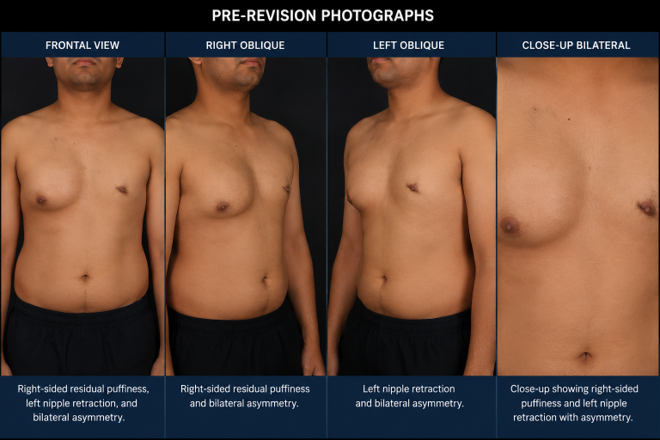
The surgery had seemed to go well. He was discharged the same day, wore his compression garment for six weeks, and attended his follow-up appointments. At three months he noticed that the right side was not flattening the way the left was. By month five there was a visible difference. The right nipple-areola area had a soft puffiness that had not gone away. Then he noticed the left side behaving differently. The nipple was pulling inward, sitting slightly lower and retracted in a way that caught the light and made it the first thing he saw when he looked in the mirror.
He went back to his original surgeon twice. Both times he was told that the swelling would continue to resolve and that the asymmetry was within the normal range of outcomes. At fourteen months post-surgery, with no change, he accepted that the original clinic was not going to address it. The result was not what he had paid for and the psychological impact of the correction he had sought making things look worse was harder to carry than the original condition had been.
He researched gynecomastia revision surgery in Hyderabad and consulted Dr. Harikiran Chekuri at Redefine for a second opinion and assessment of what revision surgery could realistically achieve.
CONSULTATION & TREATMENT PLAN
WHAT WAS ASSESSED DURING THE CONSULTATION
A detailed revision assessment was conducted across both sides separately before any surgical plan was proposed:
- Right side assessment: residual palpable glandular tissue confirmed beneath the nipple-areola complex. Fatty pseudogynecomastia excluded by palpation. The original excision had been incomplete, leaving a disc of fibrous glandular tissue that was creating the persistent puffiness. Ultrasound confirmed the finding.
- Left side assessment: nipple retraction present with scar band tethering identified on palpation. The original periareolar scar had contracted and adhered to the undersurface of the nipple, pulling it inward and downward. No residual glandular tissue on the left side.
- Symmetry assessment: measured discrepancy in nipple position documented. Right nipple sat 2mm higher than left due to the tethering effect on the left side. Chest contour asymmetry visible in frontal and oblique photographs under standardised lighting.
- Scar maturity confirmed: original surgery 14 months prior. All swelling resolved. Scars fully mature and stable. Minimum time elapsed before revision surgery is considered safe.
- Surgical approach through existing scars: revision to be performed through the original periareolar scars to avoid creating additional scarring. Access via existing scar tissue discussed with patient as technically more demanding than primary surgery.
- Realistic outcome discussed: full symmetry achievable for nipple position and chest contour. Existing periareolar scars will not disappear. Revision may improve their appearance but scar revision is not the primary goal.
- Patient goals confirmed: elimination of right-sided puffiness, correction of left nipple retraction, restoration of bilateral symmetry, no new visible scarring beyond existing periareolar lines.
WHY REVISION SURGERY WAS CHOSEN
- Fourteen months of stability confirmed the result had fully matured. Further spontaneous improvement was not possible at this stage.
- Residual glandular tissue on the right side is a definitive finding requiring surgical excision. No non-surgical intervention addresses fibrous glandular tissue.
- Scar band tethering on the left side requires surgical release. Massage, steroid injection, and other non-surgical approaches were considered and found inadequate for the degree of tethering present.
- Fat grafting to the left nipple-areola area planned after scar release to restore soft tissue volume lost through the tethering contracture, preventing re-adhesion and restoring natural contour.
- Operating through existing periareolar scars avoids any new scar creation and keeps the revision footprint within the original surgical field.
- Local anaesthesia with sedation selected over general anaesthesia given the limited, targeted nature of the revision and the patient’s preference for a quicker recovery.
PRE-OPERATIVE PHOTOS
Pre-revision photographs were taken under standardised lighting from frontal, oblique, and close-up angles to document the right-sided residual puffiness, left nipple retraction, and bilateral asymmetry prior to correction.
PROCEDURE DETAILS
- Patient positioned supine under local anaesthesia with intravenous sedation. Both sides marked and confirmed before commencement.
- Right side addressed first. Existing periareolar scar incised and dissection carried through the scar tissue to the residual glandular disc beneath the nipple-areola complex.
- Residual glandular tissue excised completely as a single specimen through the original periareolar access. Palpation confirmed complete removal with no residual firmness.
- Haemostasis achieved on the right. Wound closed in layers. Subcuticular absorbable suture at skin level within the original scar line.
- Left side addressed. Existing periareolar scar incised and scar band identified and released sharply under direct vision.
- Subdermal dissection performed to free the nipple-areola complex from all adhesions to the underlying tissue. Nipple position confirmed restored to correct anatomical level following release.
- Fat grafting performed to the left periareolar area to restore soft tissue volume, obliterate the dead space created by the release, and prevent re-tethering. Approximately 3ml of autologous fat injected.
- Left wound closed in layers with fine subcuticular suture within the original periareolar scar line.
- Bilateral compression dressing applied. No drains required. Total operative time approximately 75 minutes.
PROCEDURE FACTS
| PARAMETER | DETAIL |
| Procedure | Gynecomastia Revision Surgery. Right: residual gland re-excision. Left: scar release with fat grafting. |
| Duration | Approximately 75 minutes |
| Anaesthesia | Local anaesthesia with intravenous sedation |
| Right Side | Residual glandular tissue excised via existing periareolar scar |
| Left Side | Scar band release, subdermal adhesion release, autologous fat grafting (3ml) |
| Access | Through original periareolar scars bilaterally. No new incisions. |
| Fat Graft Donor Site | Periumbilical area via 2mm port |
| Drains | Not required |
| Hospital Stay | Day care. Discharged same day. |
| Complications | None |
POST-OPERATIVE RESULTS
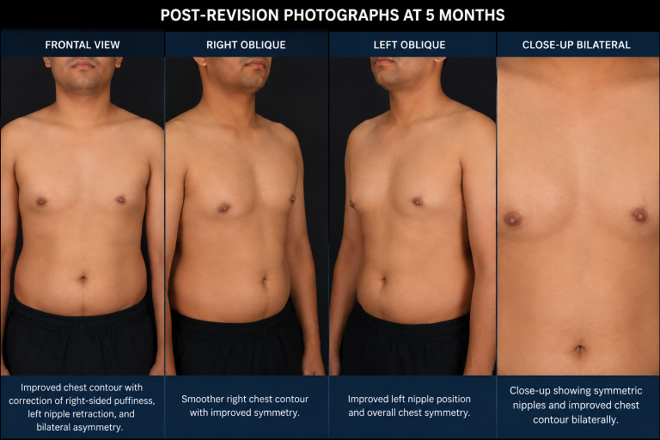
The difference was immediate. Even with the post-operative swelling, his nipples lay flat for the first time in three years. By week three, when the swelling had subsided, his chest looked exactly how he had always wanted it to look. The pectoral definition was intact. The nipples sat flat against the muscle. The scars at the areola border were healing well and becoming less visible by the day. He finally had a chest that matched his physique.
OUTCOMES AT A GLANCE
| OUTCOME METRIC | RESULT |
| Right Side Puffiness | Fully resolved. Chest flat and consistent with left side. |
| Left Nipple Retraction | Corrected. Nipple-areola complex in natural anatomical position. |
| Bilateral Symmetry | Restored. No measurable positional discrepancy at 5-month review. |
| Existing Scars | Unchanged in quality. No worsening from revision access. |
| New Scarring | None. Revision performed entirely through original periareolar lines. |
| Fat Graft Take | Good. Left periareolar volume maintained at 5 months with no resorption-related retraction. |
| Complications | None |
| Patient Satisfaction | Good |
PATIENT FEEDBACK
Feedback recorded at the 5-month follow-up visit at Redefine, Hyderabad.
Google Review
★ ★ ★ ★ ★ 5.0
Verified Patient (Name withheld for privacy)
“The original surgery left me with one side still puffy and the other nipple pulling inward. I went back to the clinic twice and was told it was normal. At fourteen months I accepted that nothing was going to change and started looking for someone who could fix it. Dr. Harikiran was the first surgeon who examined me properly and explained exactly what had happened on each side and what could be done about it. The revision was done under local anaesthesia and I was home the same day. Within two weeks I could already see the difference on the right side. At five months both sides look the same for the first time since before my original surgery. I should have come here first.”
Profile: Male, 27 years, IT Professional, Hyderabad
Procedure: Gynecomastia Revision Surgery, Redefine Gachibowli, April 2026
Doctor: Dr. Harikiran Chekuri, Redefine
Note: Due to privacy regulations, the patient’s name is not displayed. This review has been shared with the patient’s written consent.
POST-OPERATIVE CARE & RECOVERY
- Wear compression vest continuously for four weeks. Transition to daytime wear only from week five through week six.
- Keep wound sites dry for seven days. No direct water contact on the periareolar incisions before the one-week review.
- Take prescribed oral analgesics for discomfort in the first three to five days as directed.
- No lifting of objects heavier than one kilogram or overhead arm movements for two weeks.
- Light walking permitted from day two. No running, gym activity, or upper body exercise for five weeks.
- Avoid any pressure or massage directly on the left nipple-areola area for six weeks to protect the fat graft take.
- Scar massage with silicone gel to commence at four weeks on both sides once wounds are fully closed.
- Follow-up reviews at one week, four weeks, and five months.
RECOVERY TIMELINE
TIMEFRAME | WHAT TO EXPECT |
Day 1 to 3 | Mild discomfort and chest tightness. Compression dressing in place. Rest at home. |
Day 4 to 7 | Discomfort reducing significantly. One-week wound review. Can return to desk work. |
Week 2 to 3 | Compression vest continues. Right side flatness visible. Left nipple position normalising. |
Week 4 to 5 | Wounds fully closed. Scar massage commenced. Fat graft settling on left side. |
Week 6 to 8 | Compression garment discontinued. Full symmetry becoming clearly visible. Normal activity resumed. |
Month 3 to 5 | Fat graft take confirmed. Scars fading within original periareolar lines. Final result assessed at 5-month review. |
DISCLAIMER:
This case study is for informational purposes only and does not constitute medical advice. Revision gynecomastia surgery is technically more demanding than primary surgery and carries specific risks including scar tissue complications, altered blood supply to the nipple-areola complex, and variable fat graft take. A minimum of twelve months following the original procedure is typically required before revision surgery is considered. Individual results depend on the nature of the original deformity, the degree of scar formation, and individual healing response. Consult a qualified plastic surgeon experienced in revision procedures to understand what is achievable in your specific case. Patient identity withheld per confidentiality guidelines. Feedback published with written consent.
Dr. Harikiran Chekuri
MBBS, MD, MCh (Plastic Surgery)
Redefine Hair Transplant & Plastic Surgery Centre, Hyderabad
redefineu.in | +91 92371 23456