

Autologous Fat Grafting for Parry Romberg Syndrome — Natural Facial Volume Restoration
Dr. Harikiran Chekuri, a Plastic & Reconstructive Surgeon in Hyderabad, performed autologous fat grafting to restore facial volume in a patient with Parry Romberg Syndrome, addressing progressive right-sided facial hemiatrophy. The procedure involved harvesting fat from a donor site, processing it, and injecting it into the affected facial area, resulting in improved symmetry and natural volume restoration. The patient reported high satisfaction, with no immediate complications. However, long-term fat atrophy may occur, requiring re-grafting in the future.
PATIENT PROFILE
THE PROBLEM
Parry Romberg Syndrome is a rare, progressive neurological condition characterized by slow deterioration of the skin, soft tissue, and sometimes bone on one side of the face — a pattern clinically referred to as progressive hemifacial atrophy. In this patient’s case, the right side of the face showed clearly visible soft tissue volume loss, resulting in facial asymmetry that was apparent even in neutral, frontal-facing photographs. The atrophy affected the cheek, perioral region, and mid-face on the right, creating a noticeable hollowing and contour imbalance when compared to the unaffected left side. The condition had been present since adolescence and, as is characteristic of Parry Romberg Syndrome, had progressed gradually over several years before the patient sought surgical correction.
Living with visible facial asymmetry from a young age carries a quiet but persistent weight. For a 25-year-old working professional, the impact of Parry Romberg Syndrome extended well beyond the clinical — every photograph, every meeting, every mirror became a reminder of an imbalance she had not chosen. The right side of her face looked noticeably different, and no amount of styling or makeup fully addressed the underlying volume deficit. She had carried this throughout her formative years and into her working life, and by the time she came to Redefine, her goal was not dramatic transformation — it was to feel balanced, to look like herself on both sides. That clarity of expectation, combined with her patience and realism about the progressive nature of the condition, made her an ideal candidate for autologous fat grafting.
CONSULTATION & TREATMENT PLAN
WHAT WAS ASSESSED DURING THE CONSULTATION
Dr. Harikiran Chekuri carried out a detailed clinical assessment before recommending autologous fat grafting as the appropriate intervention:
- Degree and distribution of soft tissue atrophy on the right side of the face — cheek, mid-face, and perioral zones mapped
- Comparison of bilateral facial contours to quantify volume deficit and plan graft distribution
- Skin quality and recipient tissue health — assessed for vascularity and suitability for fat graft retention
- Donor site assessment — abdomen and thighs evaluated for available fat volume
- Progression status of Parry Romberg Syndrome — stability of the condition confirmed before proceeding
- Patient’s goals — improvement in facial symmetry and a natural, balanced appearance
- Medical fitness for procedure under appropriate anesthesia
WHY AUTOLOGOUS FAT GRAFTING WAS CHOSEN
- Autologous fat is biocompatible — using the patient’s own tissue eliminates the risk of rejection or foreign body reaction
- Fat grafting is the most naturalistic option for volume restoration in Parry Romberg Syndrome, closely matching the texture and feel of native soft tissue
- Unlike synthetic fillers, fat grafting offers longer-lasting correction with the potential for partial permanent retention once the graft integrates
- The procedure allows precise, layered placement across multiple tissue depths — subdermal, subcutaneous, and deep — for a smooth, three-dimensional result
- Fat grafting can be repeated if partial atrophy of the graft occurs over time, making it a safe long-term management strategy for a progressive condition
PRE- & POST-OPERATIVE PHOTOS
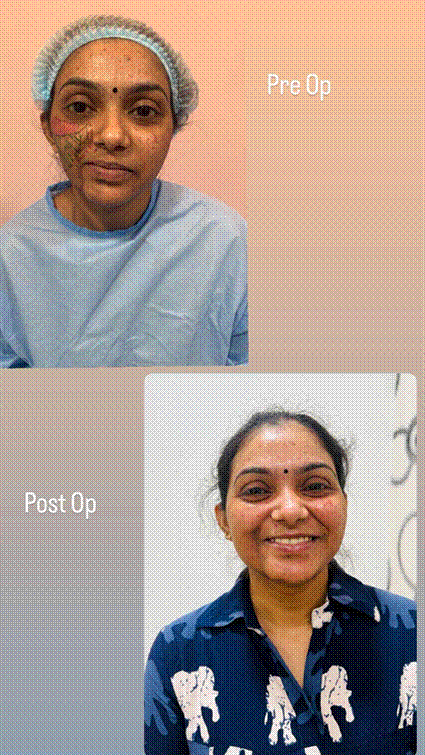
The image presents a side-by-side comparison of the patient’s appearance immediately before the procedure (pre-op, with surgical markings visible on the right cheek) and after recovery (post-op). The improvement in right facial volume, cheek contour, and overall symmetry is clearly evident. The patient’s natural expression and restored confidence are visible in the post-operative photograph.
PROCEDURE DETAILS
STEP-BY-STEP OVERVIEW
- Pre-operative markings completed — right facial atrophy zones mapped with the patient upright to account for gravity-dependent tissue distribution
- Donor site prepared — fat harvested from an appropriate donor zone (typically abdomen or thigh) using a blunt-tipped cannula and low-pressure liposuction technique
- Harvested fat processed — centrifuged and decanted to separate viable adipocytes from oil, blood, and debris
- Prepared graft loaded into fine injection cannulas for multi-plane placement
- Fat injected in small aliquots across multiple tissue depths — deep, subcutaneous, and subdermal — into the right cheek, mid-face, and perioral zones
- Volume distributed incrementally to achieve symmetrical contour matching the unaffected left side
- Over-correction applied at a conservative margin to account for expected partial resorption in the weeks following the procedure
- Micro-entry points closed; dressings applied
PROCEDURE FACTS
POST-OPERATIVE RESULTS
The post-operative result demonstrated a meaningful improvement in right facial volume and symmetry. The previously hollowed right cheek and mid-face showed clear restoration of soft tissue fullness, with contours that closely matched the unaffected left side. The natural softness and three-dimensional quality of the result reflected both the precision of graft placement and the biological integration of the transplanted fat. The patient’s facial expression in the follow-up photograph — relaxed, balanced, and genuinely at ease — captured what the clinical measurements alone could not fully convey.
OUTCOME METRICS
PATIENT FEEDBACK
“ I’m really happy with the outcome. The right side of my face looks much more balanced and natural now. The doctors explained everything clearly, the recovery was smooth, and I finally feel more confident when I look in the mirror. ”
- Profile: Female · 25 years · Working Professional · Hyderabad
- Procedure: Autologous Fat Grafting — Right Facial Restoration · Redefine, Gachibowli, Hyderabad · January 2026
- Surgeon: Dr. Harikiran Chekuri · Redefine
POST-PROCEDURE CARE & RECOVERY
INSTRUCTIONS GIVEN TO PATIENT
- Gentle facial massage as directed — promotes even fat distribution and softens any firmness in the treated area
- Prescribed analgesics for post-operative comfort — taken as needed during the first few days
- Multivitamin supplementation commenced — supports tissue healing and graft integration
- Avoid compression or firm pressure on the grafted area for minimum 3–4 weeks
- No intense exercise or activity that causes facial flushing for 2 weeks
- Protect treated area from direct sun exposure for a minimum of 4 weeks
- Follow-up appointments at Week 2, Month 1, and Month 3 for volume assessment and symmetry review