

A tummy tuck is possible for some patients with a higher BMI, but the planning is stricter and the risks are higher. This blog explains what changes in the surgery, who qualifies, and who should wait. It also covers the mistakes patients make most often when deciding how much weight to lose and when to undergo surgery.
Most people with a higher BMI have already been told no at least once. Some of those refusals were fair. Some were a quick reading of a number on a chart.The honest position sits in between. Obesity raises the risk of abdominoplasty, and the evidence on how much is mixed. It does not close the door automatically. What decides the answer is how much of the abdomen is loose skin and soft fat, how stable your weight is, and how well your general health is controlled.
According to Dr Harikiran Chekuri, a plastic surgeon in Hyderabad, “A BMI figure tells me where to start asking questions. It does not tell me whether to operate. Two patients with the same number can have completely different abdomens, and the type of fat, the skin, and the general health of the patient decide what is safe.”
What Changes in a Tummy Tuck When BMI Is Higher?
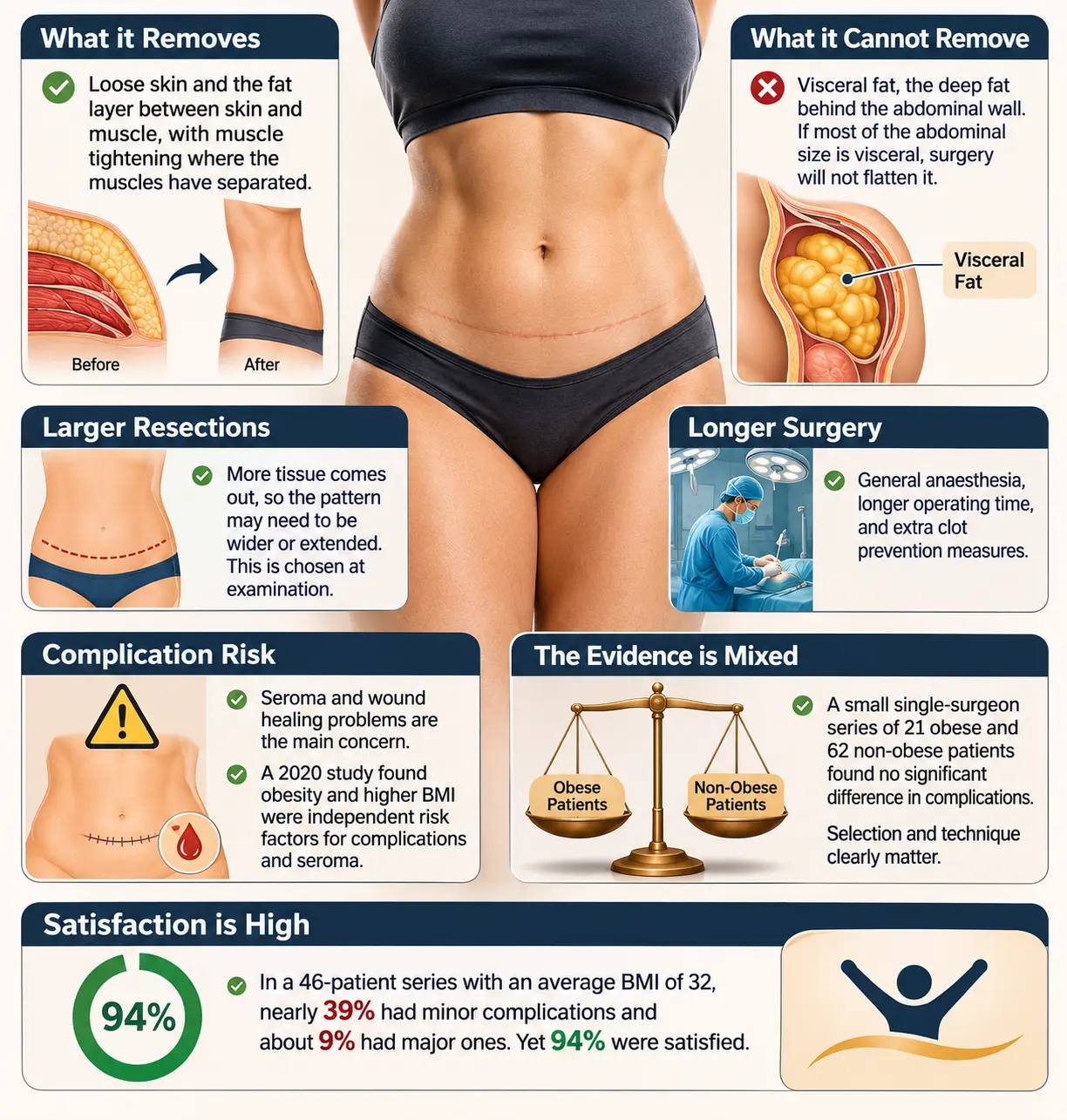
Planning a Tummy Tuck Surgery at a higher BMI starts with one question: how much of this abdomen is skin and soft fat, and how much is deep fat that surgery cannot.
Who Qualifies, Who Should Wait, and What to Do First
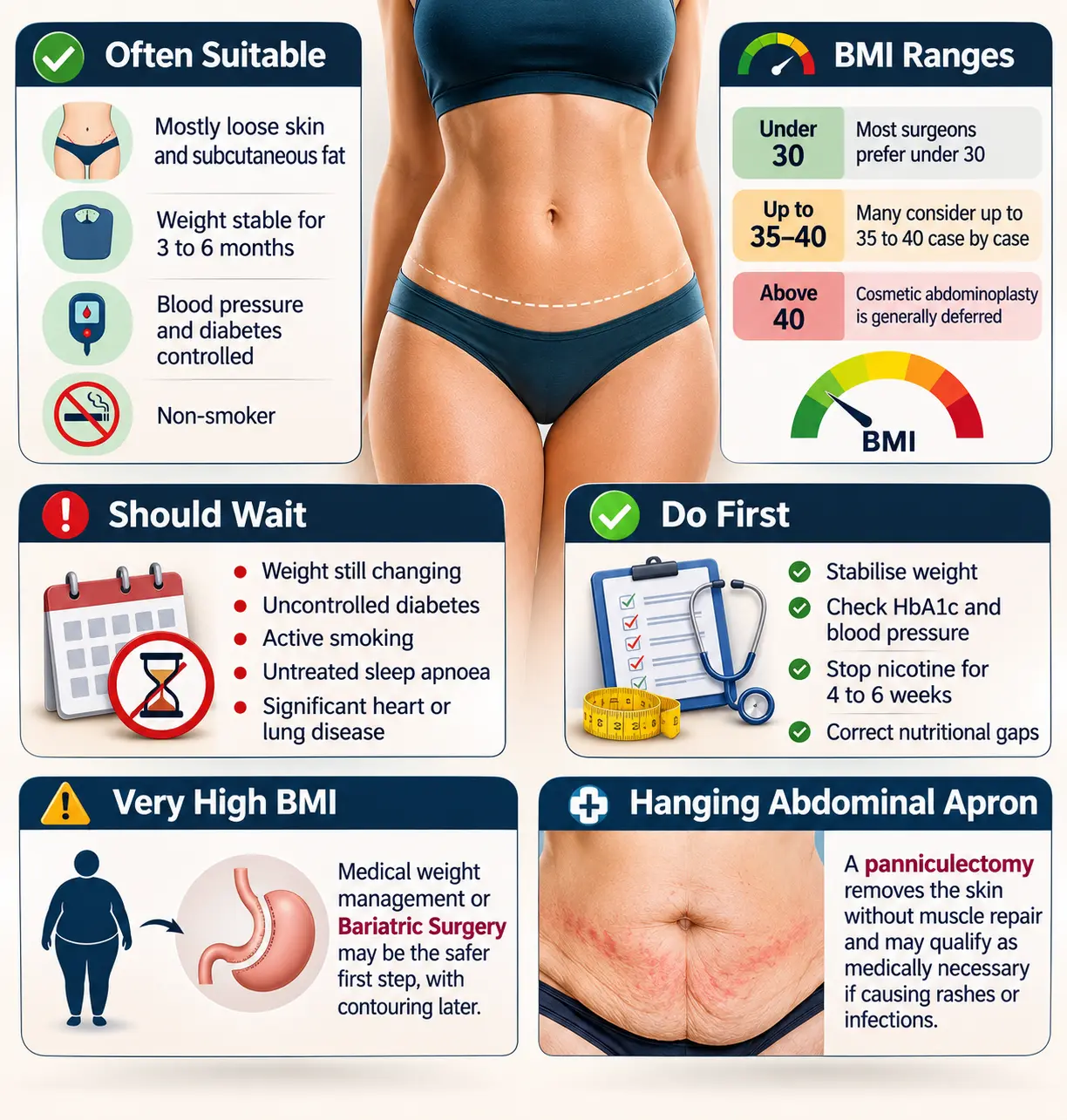
“When the problem is a skin apron causing rashes, infections, or trouble with movement, the question changes from cosmetic to medical. Panniculectomy or Tummy Tuck: What Does Insurance Cover? explains how that difference works in practice.”
What Determines the Right Treatment Approach?
The wrong call usually comes from one of four places a number taken out of context, a weight that keeps moving, a procedure used for the wrong purpose, or a risk misread in either direction.
- Visceral vs subcutaneous fat: A tummy tuck removes skin and subcutaneous fat; visceral fat behind the abdominal wall stays exactly where it is; a patient whose abdominal volume is mostly visceral will not see the result they expected, regardless of how well the surgery goes
- Weight stability: A result built on a body still changing will change with it; weight regain stretches the repair and further loss leaves new loose skin; stable weight before surgery and a realistic plan after it matter as much as the operation itself
- Waiting too long: Patients often postpone surgery while trying to lose more weight. However, skin does not always retract with weight loss, and excess skin may continue to restrict movement even after significant weight loss.
- Trusting BMI alone: A high number does not automatically rule a patient out, and a lower one does not guarantee a smooth recovery. Fat distribution, skin quality, diabetes control, and smoking history each move the risk independently of the BMI figure
Before any consultation, note your current weight, your weight six months ago, and your latest blood sugar and blood pressure readings. Those three numbers tell a bariatric surgeon more than a BMI figure does.
Frequently Asked Questions
Can obese patients get a tummy tuck?
Sometimes, case by case. Most surgeons prefer a BMI under 30 and many will consider up to 35 to 40. Above 40, cosmetic abdominoplasty is generally deferred.
What BMI is too high for a tummy tuck?
There is no universal cutoff. Complication risk rises with BMI, and elective cosmetic surgery is usually postponed above 40.
Is a tummy tuck riskier with a higher BMI?
Often, yes. Some studies show similar complication rates and others show higher overall and seroma risk. Seroma and wound healing problems are the main concerns.
Will a tummy tuck help me lose weight?
No. It removes skin and fat tissue but is not a weight loss treatment, and it cannot remove visceral fat.
Should I lose weight before a tummy tuck?
Usually you should stabilise weight first. Excess skin may not fully retract, so surgery can still be needed afterwards.
Reference
- Batac J, Hamade M, Hamade H, Glickman L. Abdominoplasty in the Obese Patient: Risk versus Reward. Plast Reconstr Surg. 2019;143(4):721e-726e.
https://pubmed.ncbi.nlm.nih.gov/30921118/ - Hammond DC, et al. Abdominoplasty in the Overweight and Obese Population: Outcomes and Patient Satisfaction. Plast Reconstr Surg. 2019;144(4):847-853.
https://pubmed.ncbi.nlm.nih.gov/31568289/ - Abdominoplasty and Patient Safety: The Impact of Body Mass Index and Bariatric Surgery on Complications Profile. Aesthetic Plast Surg. 2020;44(5):1615-1624.
https://pubmed.ncbi.nlm.nih.gov/32342171/