


Grade IV Gynecomastia Surgery with Circumareolar Lift
A 26-year-old male from Hyderabad presented with bilateral enlarged and hanging breast tissue that had developed progressively over several years. Clinically assessed as Grade IV gynecomastia with significant skin excess and ptosis of the breast mound, the condition was causing severe physical and psychological distress that had grown worse with time. Dr. Harikiran Chekuri at Redefine Clinic performed liposuction combined with direct gland excision and a circumareolar lift to remove the excess skin and reposition the nipple-areola complex. The procedure was completed in 60 minutes, the patient recovered from anaesthesia immediately, and a flat masculine chest contour was achieved at the first post-operative review.
PATIENT PROFILE
| PARAMETER | DETAIL |
| Age | 26 years |
| Gender | Male |
| City | Hyderabad, India |
| Presenting Complaint | Bilateral enlarged and hanging breast tissue causing physical discomfort and significant self-consciousness |
| Diagnosis | Grade IV Gynecomastia (mixed glandular and fatty component with skin excess and bilateral breast ptosis) |
| BMI | Elevated. Overweight presentation with generalised chest and abdominal adiposity. |
| Duration of Condition | Progressive enlargement over several years. No spontaneous reduction. |
| Hormonal Workup | Blood workup conducted prior to surgery. No pathological endocrine cause identified. |
| Anaesthetic Assessment | Completed by anaesthetist. Cleared for general anaesthesia. |
| Previous Treatments | None surgical. Lifestyle measures attempted without improvement. |
| Drug or Supplement History | None relevant disclosed |
| Date of Surgery | July 2026 |
| Outcome | Good |
THE PROBLEM
The breast tissue had been growing since his early twenties. At first it was easy to dismiss as weight-related. He had carried extra weight through his late teens and assumed the chest fullness would reduce with lifestyle changes. It did not. By his mid-twenties the breast mound had descended and the nipple had dropped below its natural anatomical position. He could feel the tissue hanging when he moved. Shirts that fitted everywhere else pulled across the chest. He had stopped removing his shirt in any social situation.
The impact on daily life was measurable. He avoided swimming pools, sporting events with teammates, and any environment that required him to be shirtless. He dressed in the dark and avoided mirrors when changing. He had tried compression undergarments for over a year. They helped him get through the day but worsened his skin underneath and provided no structural correction.
He started researching gynecomastia surgery in Hyderabad and came across Dr. Harikiran Chekuri, a plastic surgeon in Hyderabad specialising in complex gynecomastia presentations. He came to Redefine to understand what Grade IV surgery would involve and what a realistic outcome looked like for his specific presentation.
CONSULTATION & TREATMENT PLAN
WHAT WAS ASSESSED DURING THE CONSULTATION
A thorough clinical assessment was conducted before any surgical plan was finalised:
- Physical examination: bilateral Grade IV gynecomastia confirmed. Significant glandular and fatty component. Marked skin excess with breast mound ptosis. Nipple-areola complex positioned below the inframammary fold on both sides. Skin quality assessed for post-excision retraction potential.
- Grade assessment: Grade IV confirmed bilaterally. Skin excess at this grade cannot retract after liposuction and gland removal alone. Circumareolar skin reduction mandatory to restore chest contour and nipple position.
- Hormonal workup reviewed: all parameters within normal range. No endocrine pathology identified.
- Anaesthetist assessment: patient reviewed and cleared for general anaesthesia. Additional pre-operative assessment conducted given overweight status.
- Surgical markings documented: midline reference, circumareolar excision zones, gland excision zones, and liposuction zones marked bilaterally. Green cross-hatching documented the gland excision target zones. Liposuction zones marked with standard cross-hatching above and lateral to each breast mound.
- Patient goals confirmed: flat masculine chest, correction of hanging tissue, restoration of nipple position, compression garment compliance confirmed as prerequisite.
WHY LIPOSUCTION WITH GLAND EXCISION AND CIRCUMAREOLAR LIFT WAS CHOSEN
-
-
- Grade IV gynecomastia with ptosis and skin excess cannot be corrected by gland excision and liposuction alone. The redundant skin envelope requires direct excision to achieve a flat, masculine chest contour.
- Liposuction performed first to debulk the fatty component, reduce overall breast mound volume, and improve skin retraction around the gland.
- Gland excision through the periareolar access removes the central firm glandular disc that causes the persistent mound and puffiness.
- Circumareolar lift removes the ring of excess skin at the areolar border, reducing the skin envelope and repositioning the nipple-areola complex to the anatomically correct position.
- Circumareolar scar technique chosen over anchor or inverted-T approach to minimise visible scarring. The resulting scar sits at the natural colour transition of the areolar border where it fades to near invisibility.
- Combined procedure performed in a single 60-minute session under general anaesthesia to avoid staged procedures and a second general anaesthetic.
-
PRE-OPERATIVE PHOTO
Pre-operative photographs and surgical markings documented the bilateral breast mound enlargement, ptosis, nipple descent, and planned excision and liposuction zones. Green cross-hatching identifies the gland excision target zones bilaterally.
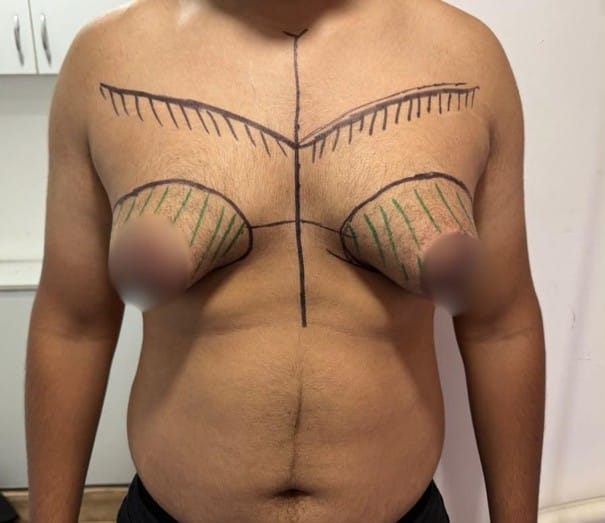
Pre-operative: frontal view with surgical markings showing liposuction zones and gland excision areas (green cross-hatch)
PROCEDURE DETAILS
- Patient positioned supine under general anaesthesia. Surgical markings reviewed and confirmed by Dr. Harikiran Chekuri before incision.
- Tumescent solution infiltrated bilaterally into the breast mound, periareolar fat, and chest wall to reduce bleeding and facilitate fat aspiration.
- Liposuction performed through 3mm access ports targeting the breast mound and lateral chest wall bilaterally to reduce fatty volume and improve skin retraction.
- Circumareolar incision made bilaterally at the areolar border. De-epithelialisation of the ring of excess skin around the areola performed to map the skin to be excised.
- Glandular disc accessed and excised completely through the circumareolar opening on each side. Excess skin envelope resected as planned.
- Nipple-areola complex repositioned and sutured into the correct anatomical position on both sides.
- Haemostasis achieved bilaterally. Wounds closed in layers with absorbable deep sutures and fine subcuticular suture at skin level.
- Compression garment applied in theatre immediately following wound closure.
- Total operative time 60 minutes. The procedure was performed by Dr. Harikiran Chekuri following the standards of plastic surgery for complex gynecomastia correction. Patient recovered from anaesthesia immediately and was discharged the same day.
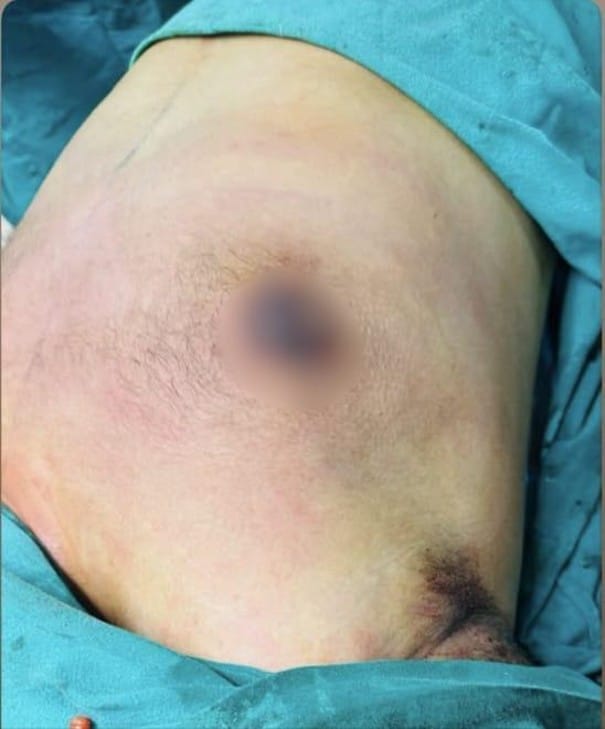
Intraoperative: close-up of left chest with nipple-areola area blurred for patient privacy
PROCEDURE FACTS
| PARAMETER | DETAIL |
| Procedure | Liposuction + Gland Excision + Circumareolar Lift (Bilateral) |
| Duration | 60 minutes |
| Anaesthesia | General anaesthesia |
| Liposuction | Breast mound and lateral chest wall bilaterally via 3mm access ports |
| Gland Excision | Complete bilateral glandular disc excision via circumareolar incision |
| Skin Reduction | Circumareolar lift with de-epithelialisation and skin excision bilaterally |
| Nipple-Areola Repositioning | Bilateral. Repositioned to anatomically correct position. |
| Drains | Not required |
| Anaesthesia Recovery | Immediate |
| Hospital Stay | Day care. Discharged same day. |
| Complications | None |
POST-OPERATIVE RESULTS
The improvement in chest contour was visible from the day of surgery. The breast mound had been eliminated and the chest wall lay flat for the first time in years. At the day 3 follow-up, wound healing was progressing cleanly on both sides and the patient reported manageable discomfort. Swelling was present as expected but the structural change was already significant. At the one-week review, swelling was reducing progressively and the circumareolar wounds were healing within the areolar border. The patient confirmed he had worn the compression garment continuously and reported no issues with compliance. At the six-week review, the chest was flat, the nipple-areola complex sat in a natural position, and the circumareolar scars were within the expected healing trajectory, fading along the areolar border.
OUTCOMES AT A GLANCE
| OUTCOME METRIC | RESULT |
| Chest Contour | Flat and masculine. Breast mound fully eliminated bilaterally. |
| Skin Excess | Resolved. Circumareolar skin reduction achieved full correction. |
| Nipple-Areola Position | Repositioned to anatomically correct position bilaterally. |
| Ptosis Correction | Complete. No residual ptosis at 6-week review. |
| Glandular Tissue | Completely excised bilaterally. Confirmed intraoperatively. |
| Scar Position | Circumareolar. Healing within natural areolar colour border. |
| Symmetry | Good bilateral symmetry achieved. |
| Compression Garment | Worn continuously for 6 weeks as instructed. |
| Complications | None |
| Outcome | Good |
PATIENT FEEDBACK
Feedback recorded at the 6-week follow-up visit at Redefine, Hyderabad.
Google Review
★ ★ ★ ★ ★ 5.0
Verified Patient (Name withheld for privacy)
“I had lived with this since my early twenties. Shirts, compression, avoiding mirrors, avoiding anything where people would see my chest. Years of it. When I came to Redefine, Dr. Harikiran explained that my case needed more than just the gland removal, that the skin itself had to be corrected. I was nervous about more scarring but he showed me exactly where the scar would sit and what it would look like in six months. The surgery was 60 minutes and I was home the same evening. Three days later at my first follow-up, the chest was already flat. Six weeks in the compression garment and the result is exactly what he described. The scars are at the edge of the areola and already fading. I cannot overstate how different my daily life feels.”
Profile: Male, 26 years, Hyderabad
Procedure: Grade IV Gynecomastia Surgery with Circumareolar Lift, Redefine Gachibowli, July 2026
Doctor: Dr. Harikiran Chekuri, Redefine
Note: Due to privacy regulations, the patient’s name is not displayed. This review has been shared with the patient’s written consent.
POST-OPERATIVE CARE & RECOVERY
- Wear compression garment continuously for 6 weeks, preferably 24 hours a day as instructed at discharge.
- Take prescribed analgesics for discomfort in the first 3 to 5 days as directed. Do not exceed the stated dose.
- Apply antiseptic ointment to the circumareolar incision sites as instructed until the one-week review.
- Take prescribed multivitamin daily throughout the recovery period to support wound healing and tissue repair.
- Maintain a high protein diet throughout recovery. Adequate protein intake is particularly important for wound healing after skin reduction procedures.
- Keep surgical sites dry for 7 days. No bathing, swimming, or direct water contact on incisions before the one-week review.
- No lifting, pushing, or upper body exercise for 6 weeks. Grade IV procedures involve more extensive tissue work and require a longer activity restriction period.
- Light walking permitted from day 2 onwards. Resume normal daily activity from week 2.
- Scar massage with prescribed silicone gel to begin at 4 weeks once circumareolar wounds are fully closed.
- First follow-up at day 3. Second follow-up at one week. Further reviews as advised.
RECOVERY TIMELINE
| TIMEFRAME | WHAT TO EXPECT |
| Day 1 to 2 | Moderate discomfort and chest tightness. Compression garment worn. Rest at home. Prescribed analgesics taken. |
| Day 3 | First follow-up. Wound check. Swelling present but chest contour significantly improved from baseline. Continue antiseptic ointment. |
| Day 4 to 7 | Discomfort resolving. Light daily activity resumed. Second follow-up at one week for wound review and dressing change. |
| Week 2 to 4 | Swelling reducing progressively. Chest flattening visible. Compression garment continues 24 hours a day. Normal daily activity from week 2. |
| Week 4 to 6 | Scar massage commenced. Circumareolar scars softening and fading within areolar border. Compression garment continues. |
| Week 6 onwards | Compression garment discontinued. Full activity resumed with surgeon clearance. Scars continue to fade over 6 to 12 months. |
DISCLAIMER:
This case study is for informational purposes only and does not constitute medical advice. Grade IV gynecomastia surgery is a more complex procedure than lower-grade presentations and involves skin reduction in addition to gland and fat removal. Individual results may vary based on the degree of ptosis, skin quality, body weight, and individual healing response. A thorough pre-operative workup and anaesthetic assessment are required before any gynecomastia surgery is undertaken. Consult a qualified plastic surgeon to assess your specific presentation and understand what outcome is realistic. Patient identity withheld per confidentiality guidelines. Feedback published with written consent.