

Achieving Clearer Skin Without Laser or Chemical Peels in a 30-Year-Old Man
A 30-year-old marketing professional from Hyderabad had been managing post-inflammatory hyperpigmentation from resolved cystic acne for five years. Two sessions of chemical peels and one session of Q-switch laser had produced limited improvement, and the downtime from laser was incompatible with his work schedule. Dr. Harikiran Chekuri at Redefine Clinic recommended copper peptide GHK-Cu therapy delivered via microneedling to regulate melanin production and accelerate dermal repair from within. After five sessions over four months, the hyperpigmented patches had faded significantly and skin tone had evened without any peeling, redness, or time away from work.
PATIENT PROFILE
THE PROBLEM
The acne had cleared at 25. The marks stayed. Dark patches across both cheeks and along the jawline that caught the light in every photograph. He had grown used to avoiding direct overhead lighting and turning slightly away from cameras. At work, client-facing presentations were something he prepared for differently than his colleagues did.
He had not been passive about it. Two rounds of chemical peels at a dermatology clinic had improved the surface texture but done very little for the deeper pigmentation. A Q-switch laser session had shown more promise but the week of redness and social downtime afterwards was not manageable. He had a client presentation four days after his laser session and spent those four days explaining his face to everyone he met. He was not willing to go through that again without a stronger guarantee.
He came across peptide therapy in Hyderabad while researching skin treatment options that did not involve downtime and booked a consultation with Dr. Harikiran Chekuri at Redefine. His primary condition was clear: results without disruption to his professional schedule.
CONSULTATION & TREATMENT PLAN
WHAT WAS ASSESSED DURING THE CONSULTATION
A detailed skin and pigmentation assessment was conducted before the treatment plan was finalised:
- Pigmentation type confirmed: post-inflammatory hyperpigmentation, epidermal and superficial dermal component, not melasma
- Distribution mapped: bilateral cheeks with highest concentration on the malar region, extending to the mandibular border
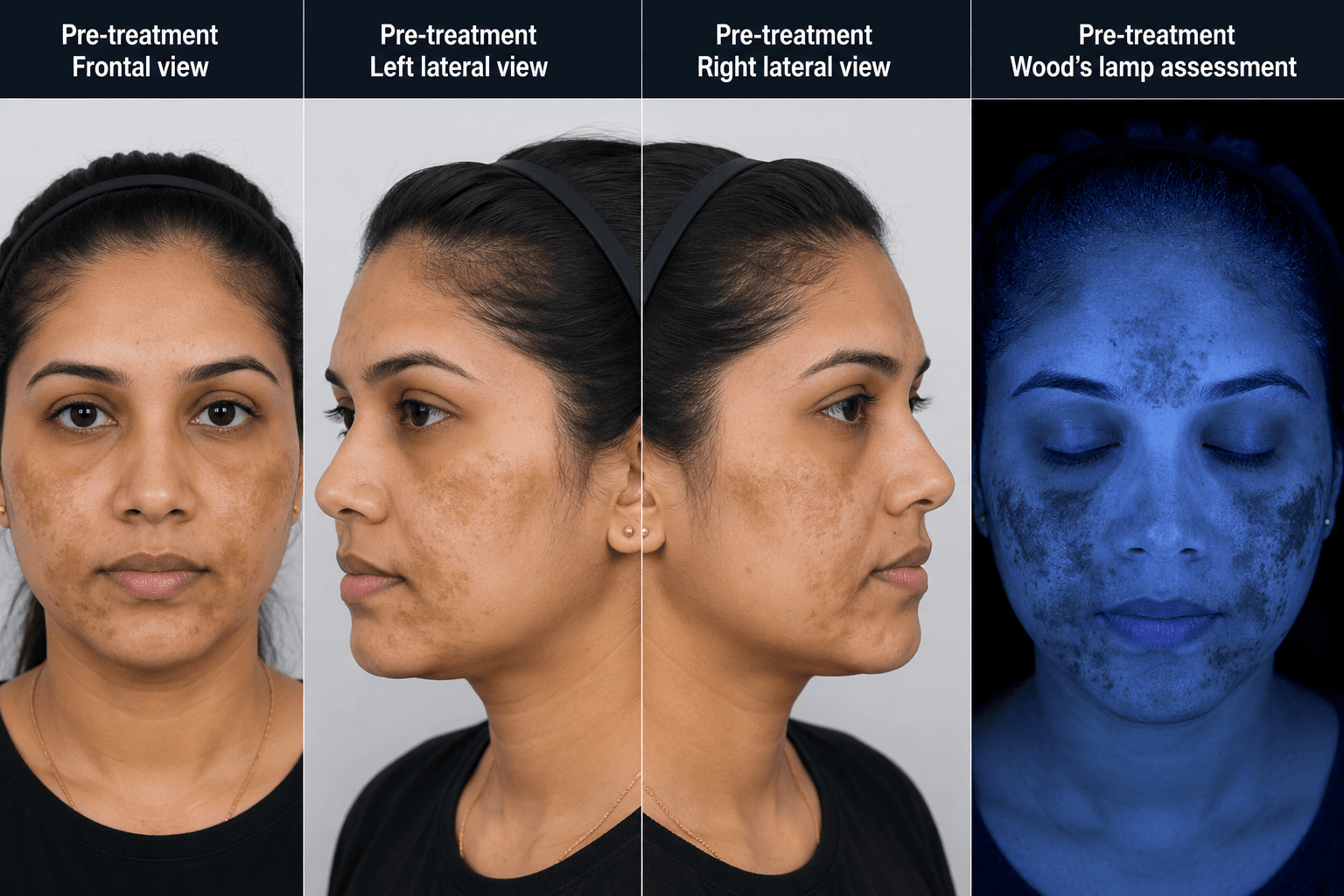
- Pigmentation depth assessed: Wood’s lamp examination confirming predominantly epidermal pigmentation with a mixed dermal component in the older patches
- Skin type evaluated: Fitzpatrick Type IV. Higher melanocyte reactivity noted, increasing risk of post-inflammatory response from ablative procedures
- Previous treatment response reviewed: chemical peels addressed epidermal layer only. Laser produced dermal response but with significant inflammation and rebound risk on this skin type
- Active acne assessment: no active lesions. Skin stable and suitable for treatment commencement
- Patient goals confirmed: visible lightening of pigmented patches, even skin tone, zero downtime, no redness or peeling incompatible with work schedule
WHY GHK-Cu PEPTIDE THERAPY WITH MICRONEEDLING WAS CHOSEN
- GHK-Cu copper peptide directly downregulates tyrosinase activity, the key enzyme driving excess melanin production in post-inflammatory hyperpigmentation
- Microneedling creates controlled microchannels that deliver GHK-Cu to the dermal layer where older, deeper pigmentation resides, bypassing the limitation of topical application alone
- GHK-Cu simultaneously stimulates collagen synthesis, addressing the mild textural irregularity that accompanies long-standing PIH
- Significantly lower post-treatment inflammation compared to ablative laser, reducing the risk of rebound hyperpigmentation on Fitzpatrick Type IV skin
- No epidermal disruption means no peeling, no raw skin, and no period of social or professional downtime
- Previous peel and laser had already shown the superficial epidermal layer could not be the only target. GHK-Cu via microneedling reaches the dermal component more effectively
- Five sessions spaced three to four weeks apart allows cumulative collagen remodelling and progressive melanin clearance without overwhelming the skin
PRE-TREATMENT PHOTOS
Baseline photographs were taken under standardised lighting and cross-sectional illumination to document the distribution, density, and depth appearance of the hyperpigmented patches before treatment commenced.
PROCEDURE DETAILS
- Skin cleansed and prepped with mild antiseptic solution. No active lesions confirmed at each session before proceeding
- Topical numbing cream applied under occlusion for 30 minutes prior to microneedling
- GHK-Cu copper peptide solution prepared at a standardised concentration. Growth factors and hyaluronic acid added to the delivery serum to support hydration and tissue repair
- Medical-grade microneedling performed at 1.0 to 1.5mm depth across the pigmented zones. Needle depth calibrated shallower over the malar prominences and adjusted deeper along the jawline where older pigmentation sat
- GHK-Cu serum applied continuously during the microneedling pass to maximise dermal penetration through open microchannels
- Post-needling, additional GHK-Cu serum massaged gently into the treated areas
- LED red light therapy applied for ten minutes to reduce inflammatory signalling and support the healing response
- Zinc oxide-based sunscreen applied before discharge. Patient counselled on strict sun avoidance for 48 hours post-session
PROCEDURE FACTS
POST-TREATMENT RESULTS
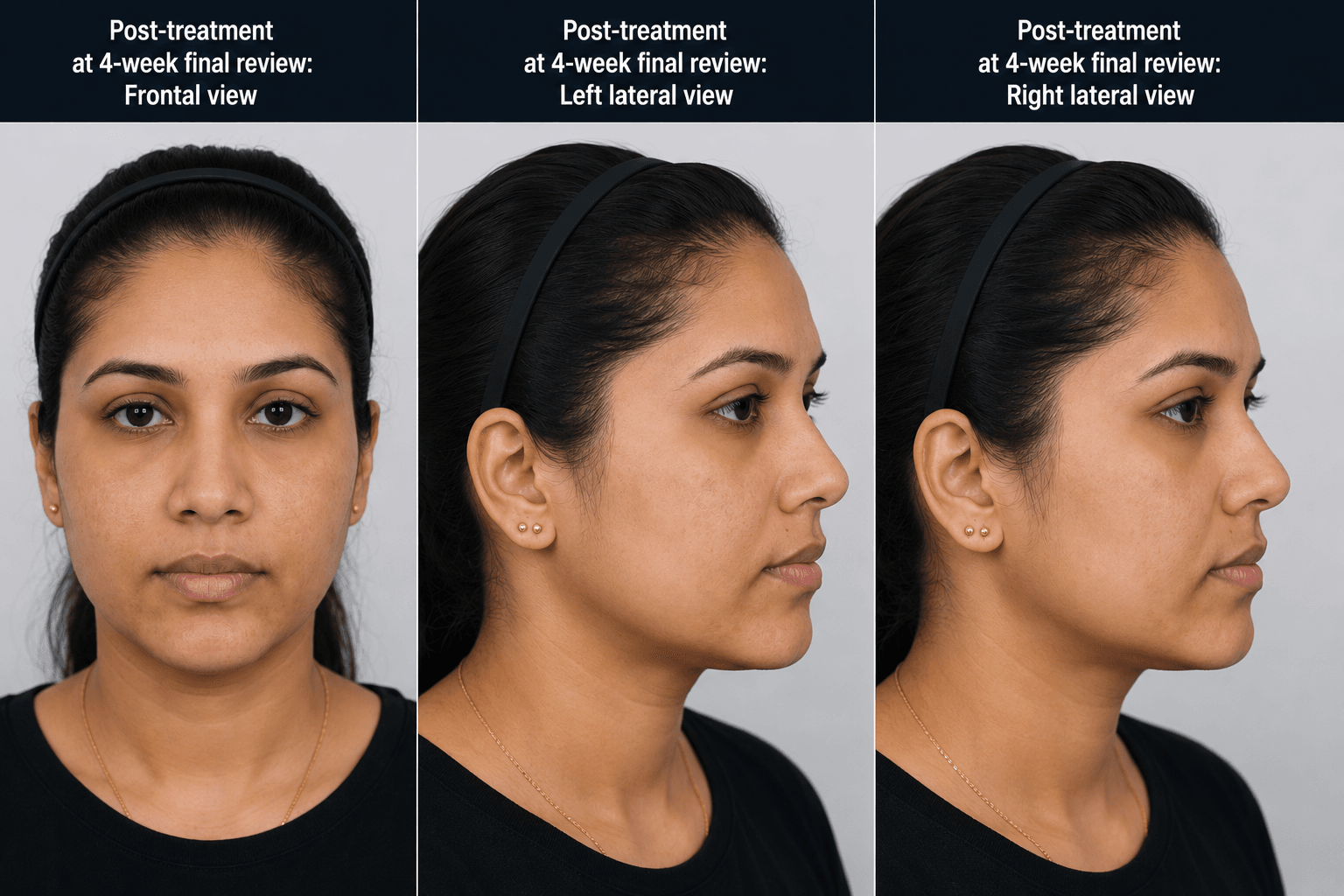
The improvement was gradual and consistent across all five sessions. After the second session the patient reported that the patches were beginning to look lighter under his bathroom mirror in the morning. By session three the change was visible in photographs for the first time. The older, deeper patches along the jawline responded more slowly than the malar patches but had faded measurably by session four. At the final review four weeks after the fifth session, the malar hyperpigmentation had lightened by an assessed 70 to 75 percent. The jawline patches showed 50 to 60 percent improvement. Overall skin tone was significantly more even. No post-inflammatory response or rebound pigmentation was observed at any point across the treatment course. The patient confirmed zero downtime across all five sessions. He attended work the following morning after each treatment without any visible reaction.
OUTCOMES AT A GLANCE
PATIENT FEEDBACK
Feedback recorded after completing the treatment course at Redefine, Hyderabad.
Google Review ★★★★★ 5.0 Verified Patient (Name withheld for privacy) “I have had this pigmentation since I was 25. Five years of it. I tried a chemical peel twice and a Q-switch laser session. The laser helped a little but the redness afterwards was not something I could manage with my work schedule. I came to Redefine not expecting a miracle but wanting something that would actually work without the downtime. By the third session I could see the difference clearly. The patches were lighter. By session five they had faded to the point where I had stopped thinking about them every time I looked in the mirror. My skin tone is even now in a way it has not been in years. No peeling, no redness, no time off work. I would recommend this to anyone sitting on the fence.” |
POST-TREATMENT CARE & RECOVERY
- Avoid touching or washing the face for 6 hours after each session to allow the peptide serum to absorb fully
- No makeup for 24 hours post-treatment to keep microchannels clear of occlusive products
- Apply prescribed healing serum twice daily for seven days following each session
- Strict sun protection with SPF 50 broad-spectrum sunscreen every morning throughout the treatment course and for four weeks after the final session. Sun exposure is the single most significant factor in rebound pigmentation
- Avoid retinol, AHAs, BHAs, and all active exfoliants for seven days post-session
- Avoid steam rooms, saunas, and vigorous exercise for 48 hours after each session to prevent excessive vasodilation of the treated skin
- Stay adequately hydrated. Avoid alcohol for 48 hours post-session
- Maintenance sessions recommended every four to six months to sustain results and address any residual pigmentation
RECOVERY TIMELINE
DISCLAIMER: This case study is for informational purposes only and does not constitute medical advice. Individual results may vary based on nasal anatomy, skin thickness, and healing response. Rhinoplasty results take 12-18 months to fully mature. Consult a qualified plastic surgeon to understand what is achievable for your specific anatomy. Patient feedback published with written consent. Patient identity withheld per confidentiality guidelines.
Dr. Harikiran Chekuri
MBBS, MD, MCh (Plastic Surgery)
Redefine Hair Transplant & Plastic Surgery Centre, Hyderabad
redefineu.in | +91 92371 23456