

regrowth but are still far from their final result. Understanding what’s biologically normal at this stage prevents unnecessary panic and helps you make informed decisions about post-op care.
Why the Crown Responds Differently Than the Frontal Zone
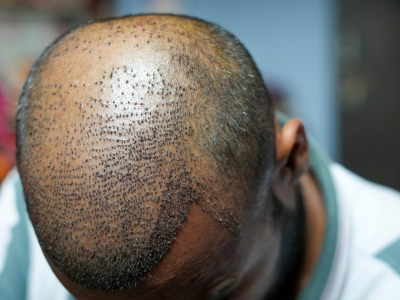
Not all scalp areas grow at the same pace after a transplant. The crown has a distinct whorl pattern and reduced blood supply compared to the frontal hairline, which directly affects how fast transplanted follicles activate.
- Whorl geometry: Grafts in the crown must be placed at varying angles to mimic the natural spiral. This precision placement affects initial recovery rate
- Vascular density: The crown has comparatively lower blood circulation, so follicles take longer to re-establish nutrient supply
- Larger surface area: The crown looks smaller than it is. It often requires more grafts spread across a wider zone, which means density builds gradually
- Growth cycle variation: Individual follicles don’t activate simultaneously. Uneven early regrowth is the norm, not a sign of failure
Patients exploring options for a hair transplant in Hyderabad often ask why their crown results lag behind their hairline. The answer is almost always anatomy, not technique.
Interested in adding PRP to your post-op protocol? Speak with a specialist about a personalised recovery plan.
What a Crown Hair Transplant Actually Looks Like at 6 Months
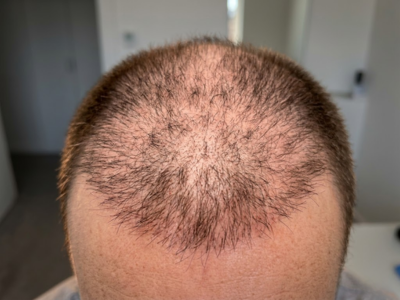
Six months marks the transition from early regrowth to active density building. What you’re seeing right now is roughly 40 to 60 percent of your final result.
- Thin, fine strands: Newly emerged hairs are often softer and less pigmented than your existing hair. This is completely normal and temporary
- Patchy coverage: Some follicles activate weeks apart. Uneven patches in the crown at this stage do not indicate poor graft survival
- Visible progress from month 4 base: If you compare month 4 to month 6 photos, most patients see meaningful improvement even if the result still looks incomplete
- Texture inconsistency: Transplanted hair and native hair may have slightly different texture until month 10 to 12 when everything normalises
This is the stage where patience is genuinely the treatment. The growth between month 6 and month 12 is often more dramatic than anything that happened before it.
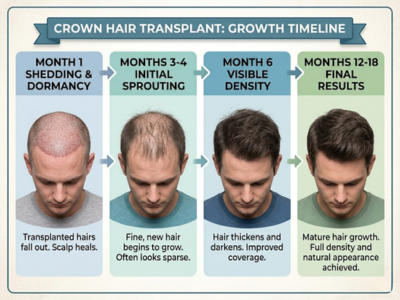
Month-by-Month Crown Hair Transplant Growth Timeline
Tracking the right benchmarks helps you evaluate progress accurately instead of comparing your month 6 to someone else’s month 14 result on social media.
| Timeframe | What's Happening |
|---|---|
| Week 1–2 | Scabbing, mild swelling, initial graft anchoring |
| Week 3–8 | Shock loss phase. Transplanted shafts shed |
| Month 3–4 | Fine hair regrowth begins. Frontal zone shows progress first |
| Month 5–6 | Crown starts catching up. 40–60% density visible |
| Month 7–9 | Significant growth acceleration. Texture begins to normalise |
| Month 10–12 | Near-final result. Density and texture largely matched to native hair |
| Month 14–18 | Full crown density in patients with larger zones or higher graft counts |
The crown consistently sits at the later end of every phase in this table. That’s not a complication. It’s biology.
Unsure whether your 6-month progress is on track? Consult a hair transplant specialist for a proper growth assessment.
When Slow Crown Results Need Medical Attention
Most delayed results are simply the crown being the crown. But some situations warrant a professional review before month 12.
- Zero visible growth by month 6: If there is no new hair whatsoever in the crown zone by month 6, a follicle survival assessment is worth doing
- Progressive thinning elsewhere: If existing hair outside the transplant zone is thinning rapidly, it may indicate underlying androgenetic alopecia that requires medical treatment alongside restoration
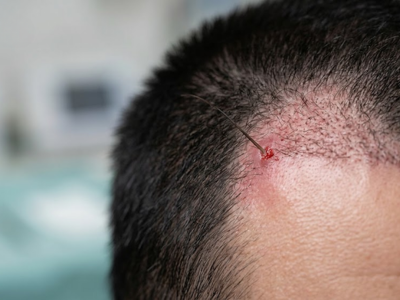
- Persistent scalp issues: Prolonged redness, folliculitis, or scalp inflammation can disrupt follicle activation and need prompt treatment
- Graft displacement: Rare but possible if post-op care instructions weren’t followed. A specialist can identify this on examination
If you’re consulting a hair restoration expert or a plastic surgeon in Hyderabad for a second opinion, bring your pre-op graft count records and any month-by-month progress photos. That gives the reviewing surgeon the clearest picture of what’s actually going on.
Think your results are lagging more than expected? Get an expert second opinion before drawing any conclusions.
Frequently Asked Questions
1. Is 6 months too early to evaluate my crown hair transplant results?
Yes. The crown typically reaches full density between months 12 and 18.
2. Why is my crown still patchy at 6 months when my hairline looks fine?
The crown has lower blood supply and a more complex follicle pattern, so it fills in later.
3. Does shock loss in the crown mean my grafts didn't survive?
No. Shock loss is the shaft falling out, not the follicle. Re-growth follows dormancy.
4. How much more growth can I expect between month 6 and month 12?
Most patients see the remaining 40 to 60 percent of their final density appear in this window.
5. Is it normal for transplanted crown hair to look thinner than my natural hair?
Yes. Newly grown hair is finer initially and thickens over the following months.