

Cosmetic surgery uses local anaesthesia, local with sedation, or general anaesthesia, and the choice depends on the operation and the patient. This blog explains what each type involves and which procedures usually suit which. It also covers what to prepare before surgery and the assumptions patients most often get wrong.
All three are used. Which one you get depends on the operation, how long it takes, your health, and how you feel about being awake. Small, contained procedures are often done with local anaesthesia alone. Mid-sized ones usually add sedation. Larger operations need general anaesthesia. So the useful question is not which type is safest in general, but which one is right for this operation and this patient.
According to Dr. Harikiran Chekuri, a plastic surgeon in Hyderabad, “Patients usually arrive with a preference, often based on fear of being put to sleep or fear of being awake. I listen to that, but the operation and the patient’s health decide the answer. The anaesthesia is chosen together with the surgery, and it is explained before the day, not on it.”
What Do the Three Types of Anaesthesia Actually Involve?
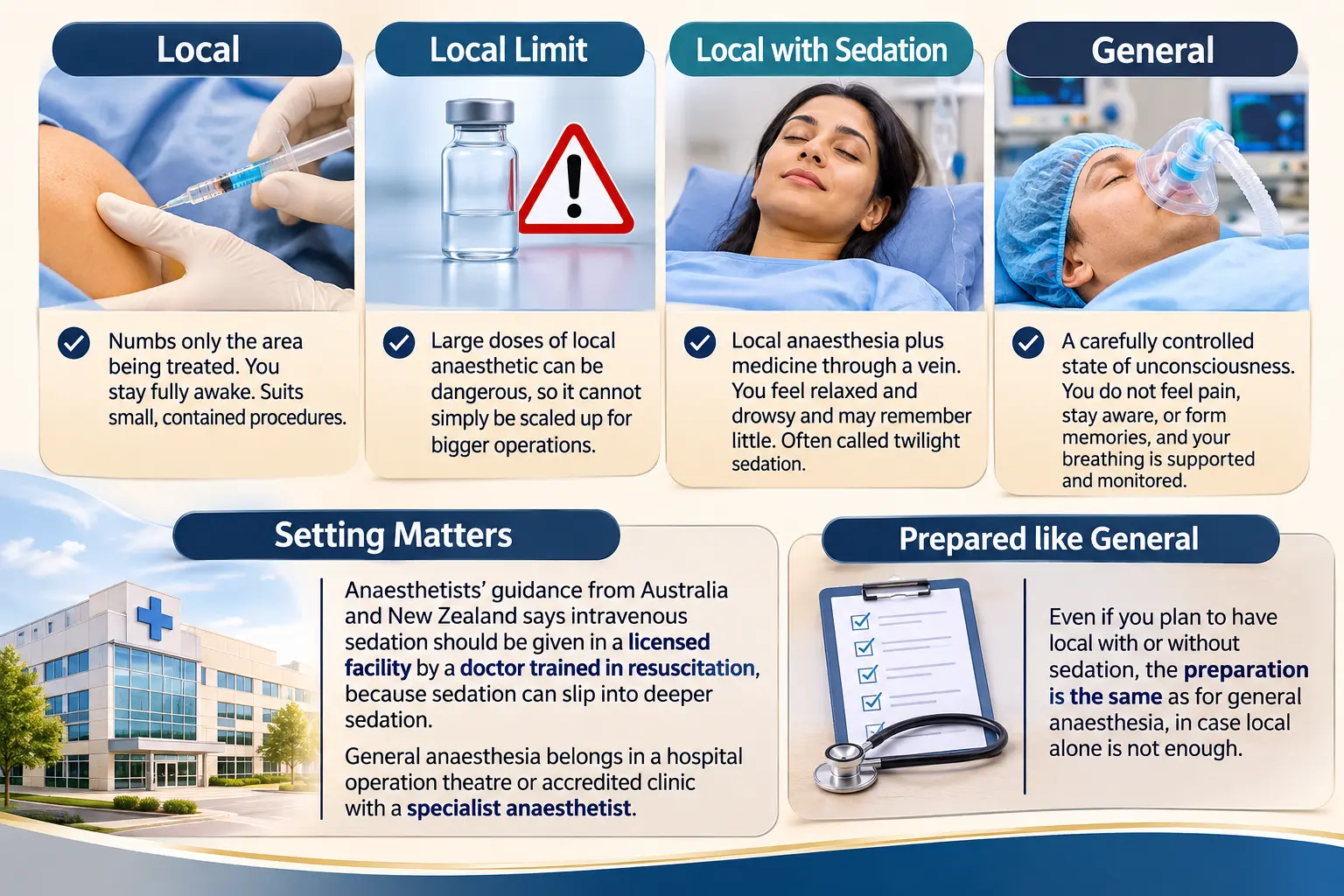
“The anaesthesia is chosen with the operation, never separately from it.That is why every plastic surgery plan we create considers both the procedure itself and how your comfort will be maintained. The same attention to individual needs guides every treatment, from surgical procedures to dermal fillers in Hyderabad.
Which Type Suits Which Procedure, and What to Do First

“Many procedures can be done under different types of anaesthesia, and the technique matters as much as the choice. Is Laser Lipo Safe? shows how one technique can be done under local or general anaesthesia depending on the patient’s needs”
What Determines the Right Treatment Approach?
- Size and length of the operation: Larger, longer procedures require general anaesthesia a small liposuction area may suit local with sedation, while large or multiple areas call for general.
- Your health and medical history: Conditions such as sleep apnoea, heart or lung issues, and smoking history directly influence which type is appropriate and safe.
- Anxiety and patient preference: Noted and considered but the operation and health profile make the final call, not comfort preference alone.
- Medicines and supplements: Disclose everything, including weight loss injections such as Mounjaro and Ozempic, which slow stomach emptying and affect anaesthesia planning.
- Surgeon and anaesthetist assessment: The combined clinical judgement of both specialists, not a fixed procedure rule, determines the right type of anaesthesia for each patient.
Procedure-to-type matching as a general guide: fillers, Botox, and hair transplants usually use local anaesthesia; eyelid surgery and mini facelifts often use sedation; tummy tucks, breast procedures, and combined surgeries such as a mommy makeover in Hyderabad typically require general anaesthesia.
Frequently Asked Questions
Which anaesthesia is used for cosmetic surgery?
All three are used. Small procedures usually use local, mid-sized ones local with sedation, and major operations general anaesthesia.
Is local anaesthesia safer than general anaesthesia?
For small procedures, yes. For larger ones, the amount of local anaesthetic needed can become unsafe, so matching the type to the operation is what keeps you safe.
Will I be awake with sedation?
You will feel relaxed and drowsy and may remember little. Sedation can deepen, so a trained team must monitor you throughout.
Do I need to fast before surgery?
Usually yes for sedation and general anaesthesia. Your team gives you exact timings.
Should I tell my team about weight loss injections?
Yes. These medicines slow stomach emptying, which matters for anaesthesia, so your anaesthetist needs to know before surgery.
Reference
- Australian and New Zealand College of Anaesthetists. Anaesthesia and Cosmetic Surgery. ANZCA patient information.
https://www.anzca.edu.au/patient-information/about-anaesthesia/anaesthesia-and-cosmetic-surgery - Safe Anesthesia for Office-Based Plastic Surgery: Update from the PRS Korea 2018. PMC.
https://pmc.ncbi.nlm.nih.gov/articles/PMC6536880 - Ambulatory Anesthesia in Plastic Surgery: Opportunities and Challenges. Ambulatory Anesthesia. 2015;2:91-102. https://www.dovepress.com/ambulatory-anesthesia-in-plastic-surgery-opportunities-and-challenges-peer-reviewed-fulltext-article-AA