Hyderabad’s hard water, humid climate, high-pressure careers, and protein-light diet do not cause hair loss on their own but in someone already predisposed, they push the timeline forward by years. This blog covers what each local factor does to the follicle, which loss patterns show up most here, and what to address before clinical treatment becomes the only option.
Hyderabad’s water is hard. The summers are humid and hot. The city runs on long working hours and high-pressure tech and pharma careers. None of these help hair. Patients who would have started losing hair at forty are showing up at twenty-eight. The timeline has moved forward. The cause has not changed but everything sitting on top of it has.
Most people living here do not connect their environment to their hair. That is the first problem.
According to Dr Harikiran Chekuri, a plastic surgeon in Hyderabad, “Patients seeking hair transplant treatment in Hyderabad may experience hair loss due to two key factors: genetic predisposition and lifestyle triggers. Addressing only one and ignoring the other produces a partial result. Both have to be managed, and the order matters.”
What Does Hyderabad’s Environment Specifically Do to Hair?
Each factor here acts on a different part of the hair system. None of them work alone most Hyderabad patients are dealing with three or four at once.
| Factor | What It Does | What Helps |
| Hard water | Mineral deposits sit on the shaft and block the follicle opening over time | Shower filter, chelating shampoo once weekly |
| Heat and humidity | Scalp stays wetter longer, sebum turns over faster, dermatitis flares up | Wash every two to three days |
| Occupational stress | Cortisol stays raised for weeks, follicles enter the resting phase prematurely | Improve sleep and manage stressors |
| Local diet patterns | Follicles run short of protein and iron on a rice-and-fried-food diet | More protein daily, ferritin confirmed via blood test |
| Sun exposure | Cuticle and scalp barrier take UV damage on long outdoor commutes | Cover scalp during peak hours |
| Dehydration | Follicle nutrition drops when the bloodstream is running low | Two to three litres of water daily |
Hard water is what most patients miss entirely. Moving to Hyderabad from Pune, Bengaluru, or Chennai the shedding accelerates within months. A shower filter costs very little. Most never try it.
PRP treatment performs better when the scalp environment is not working against it. Lifestyle correction and clinical treatment together consistently beat either alone.
Which Hair Loss Patterns Show Up Most in Hyderabad Patients?
The types are the same everywhere. The rate at which they progress here is not.
- Early androgenetic alopecia: Genetic pattern loss arriving a decade ahead of schedule. High-stress roles, disrupted sleep, and low ferritin all push the process forward in follicles that were already predisposed to it
- Telogen effluvium: Diffuse shedding across the scalp, not concentrated at the crown the trigger was usually months earlier a sustained work crunch, a crash diet, or an illness the patient has already forgotten about by the time they notice the hair fall or shedding.
- Scalp inflammation: Year-round humidity keeps Malassezia active; seborrhoeic dermatitis and dandruff are far more prevalent in Hyderabad than in drier cities;
- Iron deficiency shedding: Low ferritin shows up consistently on the hair loss It is common among all age groups in women, regularly missed because haemoglobin looks normal while ferritin has quietly dropped
More than one of these usually runs together. Which is the primary cause determines where treatment starts.
Patients who have already addressed lifestyle factors can read why patients get rejected for hair transplant to understand the criteria for surgical candidacy.
Does Lipoma Come Back After Removal?
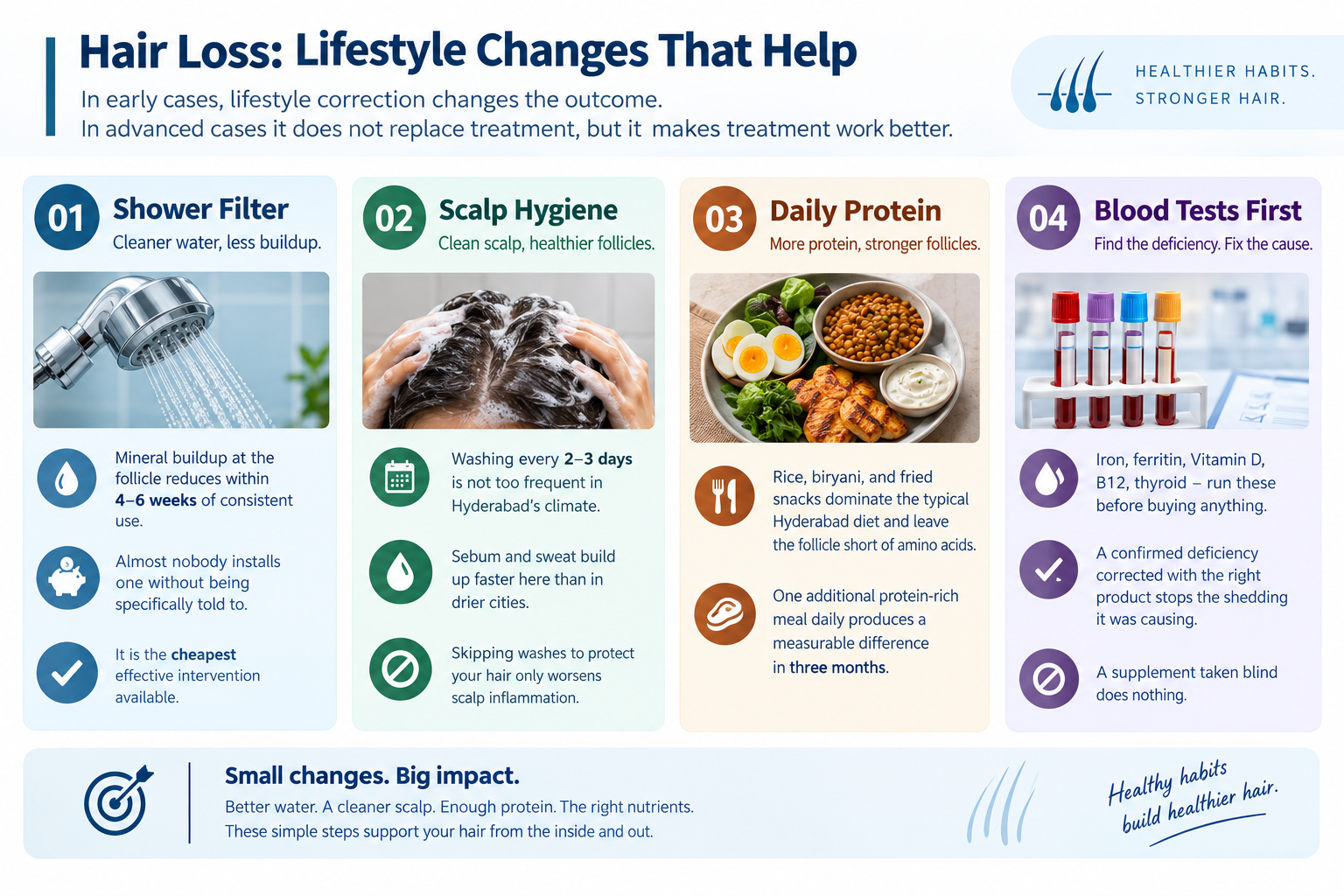
If shedding continues after three to four months of consistent changes, seek a clinical assessment. Younger patients can read whether to wait for a hair transplant in their 20s to better understand the timing and suitability of the procedure.
Key Takeaway
- Hard water blocks the follicle opening over time a shower filter is the cheapest fix most patients never try.
- Genetic loss and lifestyle triggers run together. Fixing only one gives you half a result.
- Low ferritin won’t show on a haemoglobin test. Get ferritin checked separately before assuming nothing is deficient.
- Washing every two to three days in Hyderabad’s climate is not too frequent skipping washes worsens scalp inflammation.
- Three to four months of consistent changes is the test. Still shedding after that it needs a clinical eye, not another supplement.
Frequently Asked Questions
Does Hyderabad’s hard water cause permanent hair loss?
Not independently. Mineral buildup damages the shaft and blocks the follicle opening. In patients with existing genetic predisposition, both factors together move the permanent loss timeline forward.
How often should hair be washed in Hyderabad?
Every two to three days. A longer gap lets sebum and sweat accumulate on the scalp. Inflammation follows.
Does the IT sector lifestyle cause hair loss?
Sustained cortisol elevation is a confirmed driver of telogen effluvium. Irregular sleep and missed meals keep cortisol high. The lifestyle does not help.
What blood tests matter most?
Iron, ferritin, Vitamin D, B12, thyroid function. In Hyderabad patients presenting with unexplained hair loss, one or more of these tests may reveal an underlying deficiency or imbalance.
Does changing diet reverse hair loss?
Correct a confirmed deficiency and the shedding driven by it stops. Genetic pattern loss does not respond to diet.
When does lifestyle correction stop being enough?
Three to four months of genuine consistent changes. Deficiencies confirmed and corrected. Shedding still continuing. At that point, a full clinical assessment is the right move.
Reference
- Bancroft LW, Kransdorf MJ, Peterson JJ, O’Connor MI. Benign fatty tumors: classification, clinical course, imaging appearance, and treatment. Skeletal Radiol. 2006;35(10):719–733.
https://pubmed.ncbi.nlm.nih.gov/16927086/ - Charifa A, Badri T, Harris BW. Lipoma Pathology. In: StatPearls. StatPearls Publishing; 2024.
https://www.ncbi.nlm.nih.gov/books/NBK482343/ - Mustoe TA, Cooter RD, Gold MH, et al. International clinical recommendations on scar management. Plast Reconstr Surg. 2002;110(2):560–571.
https://pubmed.ncbi.nlm.nih.gov/12142678/