
Bio FUE Hair Transplantation — Natural Hairline Restoration with 1500–2000 Grafts
Dr. Harikiran Chekuri, a Hair Transplant Specialist in Hyderabad, performed a Bio FUE hair transplant on a patient with Androgenetic Alopecia (Grade 2), restoring a natural hairline. The procedure, done under local anesthesia, involved the placement of 1500–2000 grafts in a single session, with excellent results and high patient satisfaction. Post-operative swelling and temporary shedding were the only expected side effects, with no complications reported.
PATIENT PROFILE
THE PROBLEM
The patient presented with Grade 2 Androgenetic Alopecia (AGA), characterized by progressive recession of the frontal hairline along the bitemporal margins. Clinically, there was notable miniaturization of follicles in the frontal scalp zone, with visible thinning extending into the hairline. The recession was bilateral and symmetrical, classified as moderate for the patient’s age. Close examination of the hairline also revealed fine scaling, suggesting a degree of scalp sensitivity alongside the androgenic process. The donor region at the occipital and parietal scalp showed good follicular density, making the patient a strong candidate for surgical restoration.
At just 28 years of age, the patient had been living with a receding hairline for three to four years. For a young working professional, hair loss of this kind quietly reshapes confidence in professional settings, social interactions, and personal self-image. The patient had not pursued any prior treatment. By the time he arrived at Redefine, his goal was clear — a natural-looking, permanent solution that would restore his hairline without visible evidence of surgery. His expectations were realistic, his motivation was genuine, and he was in excellent health, making him an ideal candidate for Bio FUE.
CONSULTATION & TREATMENT PLAN
WHAT WAS ASSESSED DURING THE CONSULTATION
Dr. Harikiran Chekuri conducted a thorough pre-operative evaluation covering all clinical and personal parameters before arriving at a treatment recommendation:
- Degree and pattern of hair loss — confirmed Grade 2 AGA with bitemporal recession
- Frontal scalp skin condition — examined for scarring, inflammation, and follicular miniaturization
- Donor area density — occipital and parietal zones assessed for follicular yield and quality
- Hair caliber and curl pattern — important for estimating graft coverage and cosmetic density
- Patient’s hairline goals — restoration of a natural, age-appropriate frontal hairline
- Medical fitness — routine assessment for local anesthesia and single-session surgical safety
WHY BIO FUE WAS CHOSEN
- FUE technique selected over FUT to avoid a linear donor scar — critical for a young patient who may prefer short hairstyles
- Bio FUE protocol involves advanced graft preservation solutions to enhance follicle viability and improve growth outcomes
- 1500–2000 grafts determined as sufficient to achieve full frontal hairline restoration without over-harvesting the donor zone
- Local anesthesia chosen for patient safety, rapid recovery, and day-procedure feasibility
- Hairline design customized to the patient’s facial structure and natural growth angle for an undetectable result
PRE-OPERATIVE PHOTOS
Before the procedure, Dr. Harikiran Chekuri made precise pre-operative markings with the patient standing upright. These markings define the midline, inframammary fold, breast footprint, and implant pocket boundaries — a critical step for bilateral symmetry and accurate implant placement.
PRE-OP — HAIRLINE CLOSE-UP VIEWS

PRE-OP — FRONTAL & TOP VIEWS
PROCEDURE DETAILS
- Pre-operative hairline marking carried out with the patient standing — natural frontal design finalized
- Donor zone (occipital and parietal scalp) shaved and prepared for FUE extraction
- Local anesthesia administered at donor and recipient sites — patient remained comfortable throughout
- Individual follicular units extracted using micro-punch FUE technique with minimal trauma
- Grafts processed, categorized by follicular unit type (single, double, multi), and stored in Bio FUE preservation solution
- Recipient site incisions created at precise angulation to replicate natural hair growth direction
- 1500–2000 grafts implanted into frontal hairline zone — density and distribution planned for a natural result
- Intraoperative check performed for symmetry, density, and hairline aesthetics
- Donor area cleaned and dressed; recipient area dressed with light gauze padding
PROCEDURE FACTS
A INTRAOPERATIVE — DONOR ZONE EXTRACTION
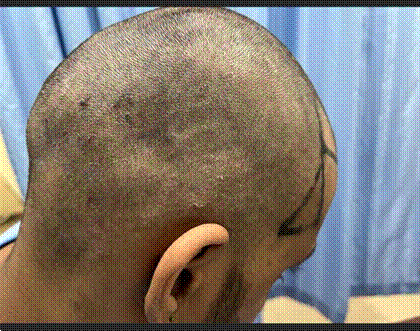
The images below show the occipital and parietal donor zones following follicular unit extraction. The characteristic micro-punch FUE pattern is visible across the shaved scalp. Extraction density was carefully controlled to preserve the natural appearance of the donor area and avoid over-harvesting.
DONOR AREA — POSTERIOR & LATERAL VIEWS
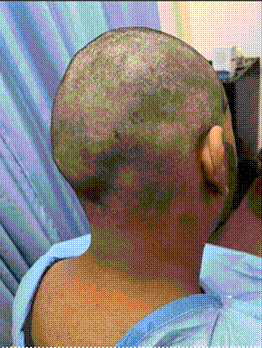
Posterior view — extraction pattern
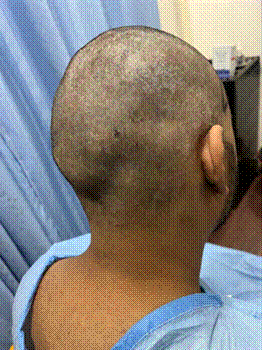
Lateral view — right donor
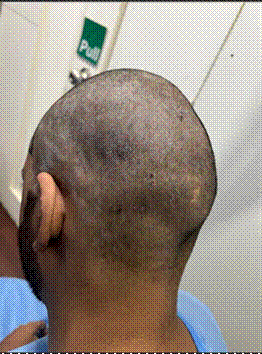
Posterior left — donor zone
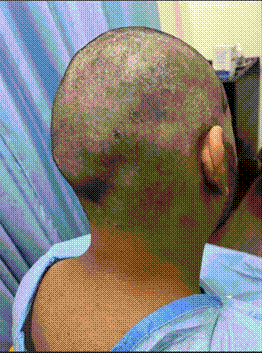
Close-up — extraction density
Overview — full donor region
POST-OPERATIVE RESULTS — DAY 0 (IMMEDIATE)
Before the procedure, Dr. Harikiran Chekuri made precise pre-operative markings with the patient standing upright. These markings define the midline, inframammary fold, breast footprint, and implant pocket boundaries — a critical step for bilateral symmetry and accurate implant placement.
IMMEDIATE POST-OP — FRONTAL VIEW

IMMEDIATE POST-OP — LATERAL VIEWS


IMMEDIATE POST-OP — CLOSE-UP VIEWS

OUTCOMES AT A GLANCE
OUTCOME METRICS
PATIENT FEEDBACK
Feedback was recorded during the patient’s post-operative follow-up at Redefine, Gachibowli. The patient had been closely monitored through her recovery and offered the following observations.
“ I’m very happy with the hair transplant experience. The procedure was smooth and the team at Redefine was supportive throughout. Even with 1500 to 2000 grafts, everything felt well managed. My hairline already looks natural, and I’m confident the final results will be even better as the growth progresses. ”
- Profile: Male · 28 years · Working Professional · Hyderabad
- Procedure: Bio FUE Hair Transplantation · Redefine, Gachibowli, Hyderabad · January 2026
- Surgeon: Dr. Harikiran Chekuri · Redefine
POST-PROCEDURE CARE & RECOVERY
- Gentle saline spray to recipient zone every 2–3 hours for the first 5 days — prevents crust formation
- Prescribed oral antibiotics and anti-inflammatory medication for 5–7 days
- Vitamin supplements (biotin, zinc) commenced from Day 1 to support graft nutrition
- Avoid direct sunlight on scalp for minimum 4 weeks — use a soft cap outdoors
- No strenuous exercise, swimming, or heavy physical exertion for 3 weeks
- Sleep with head elevated at 30–45 degrees for the first 5 days to reduce forehead swelling
- No hair washing for 72 hours; gentle shampooing technique demonstrated from Day 4
- Follow-up review scheduled at Day 7, Month 1, Month 3, and Month 6
