

FUE Hair Transplant with 2000 Grafts in a Young Professional with Early-Onset Hair Loss
A 26-year-old software developer from Hyderabad had been watching his hairline recede since his early twenties. The temples pulled back first, then the frontal zone began thinning. Three years of minoxidil and finasteride had slowed the progression but could not reverse what was already lost. After researching his options, he consulted Dr. Harikiran Chekuri at Redefine Clinic. A carefully planned FUE procedure with 2000 grafts restored his hairline with a conservative design built to hold up as he aged, giving him back the appearance he had been losing since his early twenties.
PATIENT PROFILE
| Parameter | Detail |
| Age | 26 years |
| Gender | Male |
| Occupation | Software Developer |
| City | Hyderabad, India |
| Presenting Complaint | Receding temples, thinning frontal zone, visible scalp at hairline |
| Diagnosis | Androgenetic Alopecia, Norwood Grade 2 to 3 |
| Duration of Hair Loss | Progressive thinning since age 23 (3 years) |
| Family History | Father with Norwood Grade 5 by age 40, paternal uncle with similar pattern |
| Previous Treatments | Minoxidil 5% topical (18 months), Finasteride 1mg oral (10 months) |
| Response to Medication | Partial. Progression slowed, existing recession unchanged |
| Date of Procedure | November 2025 |
| Outcome | Excellent |
THE PROBLEM
He first noticed it at 23. A little more forehead visible in photographs. Temples that had pulled back further than he remembered. He put it down to stress from a new job and carried on. By 24 it was harder to dismiss. The frontal zone had thinned visibly and styling could no longer cover it.
He started minoxidil the same week he accepted what was happening. A dermatologist added finasteride ten months later. Together, the medications held the line. The progression slowed. But the recession did not reverse. The temples stayed hollow. The frontal scalp still showed through under direct light. Every video call, every team photograph, every overhead light in a meeting room was a reminder of something medication alone could not fix.
At 26, the gap between how he looked and how he expected to look at his age had become a daily frustration. He started researching hair transplant options in Hyderabad and booked a consultation with Dr. Harikiran Chekuri at Redefine.
CONSULTATION & TREATMENT PLAN
WHAT WAS ASSESSED DURING THE CONSULTATION
A thorough hair and scalp evaluation was conducted before any surgical recommendation was made:
- Norwood classification confirmed: Grade 2 to 3, frontal and bilateral temporal recession
- Dermoscopy of frontal zone: significant miniaturisation of native follicles, confirming active androgenetic alopecia
- Donor area assessment (occipital region): 75 to 80 follicular units per cm2, good caliber, strong coverage potential
- Hair characteristics: black, straight, medium caliber, well suited to FUE extraction
- Scalp laxity: moderate, no restriction for FUE technique
- Future loss trajectory: discussed based on family history. Grade 4 to 5 by mid-forties a realistic projection
- Patient goals confirmed: natural hairline, age-appropriate design, result that accounts for future progression
- Medication plan reviewed: finasteride and minoxidil to continue post-procedure to protect native hair
Why FUE Was Chosen
- No linear scar. Important for a young patient who may wear short hair in the future
- Minimal downtime suited to his work schedule
- Precise single-hair placement at the hairline for a natural, irregular edge
- Selective harvesting preserves the donor area for a potential second session if future loss requires it
- Less post-operative discomfort than strip harvesting
- Conservative graft count of 2000 chosen to restore recession without depleting donor reserves
PRE-OPERATIVE PHOTOS
Baseline photographs were taken from the front, both lateral angles, and overhead to document the recession pattern, plan the new hairline position, and calculate graft distribution across the recipient zones.
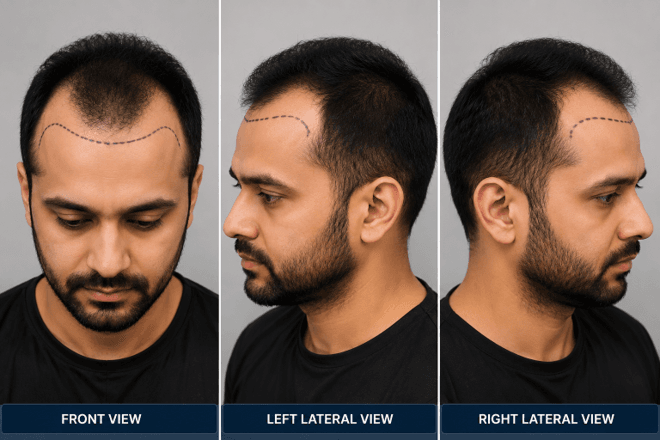
Pre-operative photographs: frontal view | lateral view | oblique view
PROCEDURE DETAILS
PROCEDURE DETAILS
- New hairline designed collaboratively with the patient prior to procedure. Conservative position appropriate for a male in his mid-twenties, planned to remain proportionate as he ages
- Patient reviewed and confirmed hairline design before anaesthesia was administered
- Donor area trimmed and prepared in the occipital region
- Local anaesthesia administered via tumescent technique to donor and recipient areas
- FUE extraction using 0.9mm motorised micro-punch
- 2000 grafts harvested over approximately 3.5 hours
- Grafts sorted by follicular unit size and kept in chilled holding solution to maintain viability
- Recipient sites created with custom blades at precise angles and direction matching the patient’s natural hair growth pattern
- Single-hair grafts placed at the outermost hairline for natural irregularity and soft frontal edge
- Double and triple-hair grafts placed behind the hairline and in temporal angles for density
- Post-procedure bandaging applied and discharge care instructions provided
PROCEDURE FACTS
| Parameter | Detail |
| Procedure | Follicular Unit Extraction (FUE) Hair Transplant |
| Total Grafts | 2000 grafts (approximately 4200 to 4500 hairs) |
| Duration | Approximately 6 hours (single session) |
| Anaesthesia | Local anaesthesia with oral sedation |
| Extraction Tool | 0.9mm motorised micro-punch |
| Recipient Area | Frontal hairline and bilateral temples |
| Donor Area | Occipital scalp |
| Graft Breakdown | Single-hair grafts at hairline, double and triple-hair grafts for frontal density |
| Hospital Stay | Day care. Discharged same evening |
| Complications | None |
POST-OPERATIVE RESULTS
Post-operative photographs were taken at the 12-month follow-up from identical angles to the pre-operative baseline to document the hairline restoration, temple rebuilding, and frontal density achieved.
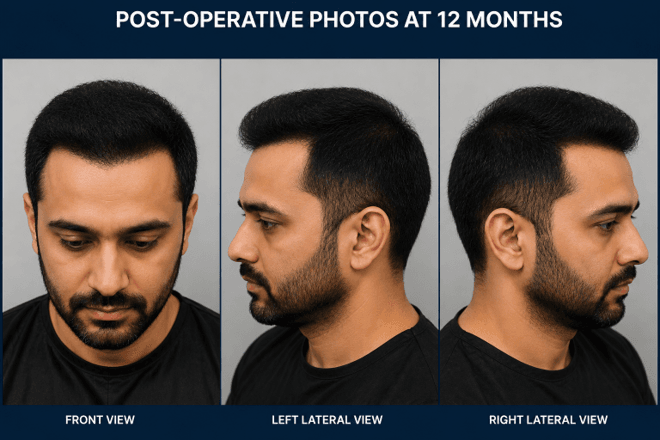
Post-operative photographs at 12 months: frontal view | lateral view | oblique view
POST-OPERATIVE CARE & RECOVERY
The transplanted hair went through the expected cycle. Scabs formed in the first few days and cleared by day ten. Shock loss followed in weeks two to four. The transplanted hairs shed and the scalp returned to roughly its pre-procedure baseline. The waiting period that followed was the hardest part. By month four, fine new hairs were emerging at the temples and along the frontal hairline. By month eight the result was clearly taking shape. At the twelve-month review the hairline was fully established, natural in appearance, and indistinguishable from the surrounding native hair. He looked his age again.
What to Expect Over Time
| Timeframe | What to Expect |
| Day 1 to 3 | Mild swelling, small scabs forming around grafts. Rest at home. |
| Day 4 to 7 | Swelling resolves. Scabs begin separating. Can return to desk work. |
| Week 2 to 4 | Shock loss. Transplanted hairs shed. Normal and expected. |
| Month 2 to 3 | Dormant phase. Grafts establishing blood supply below surface. Little visible change. |
| Month 4 to 6 | New growth begins. Fine hairs emerging at temples and hairline. |
| Month 6 to 8 | Density increasing noticeably. Hairline shape becoming well-defined. |
| Month 10 to 12 | Near-final result. Hair thickening and maturing. Natural appearance confirmed. |
Outcomes at a Glance
| Outcome Metric | Result |
| Hairline | Natural, conservatively placed, age-appropriate. Norwood 1 to 2 appearance |
| Temple Points | Rebuilt bilaterally, masculine facial frame restored |
| Frontal Density | Good coverage, smooth blend with native hair, no visible transition line |
| Graft Survival | Estimated above 93 percent at 12-month assessment |
| Donor Area | No visible scarring, reserve maintained for future session if required |
| Native Hair Stability | No measurable progression since procedure, maintained on medication |
| Natural Appearance | Undetectable as a transplant result |
| Complications | None |
Patient Feedback
Feedback recorded at the 12-month follow-up visit at Redefine, Hyderabad.
Google Review ★★★★★ 5.0
Verified Patient (Name withheld for privacy)
“I was nervous about coming in at 26. Most content I found online was aimed at older men and I was not sure if I was a good candidate. Dr. Harikiran explained everything clearly, how they plan the hairline for where you will be at 40, not just where you are now. That made a lot of sense to me. The procedure was long but comfortable throughout. The shedding phase afterwards was difficult to sit through. But around month four the hair started coming back and by month eight I could see exactly what the result was going to be. At twelve months it looks completely natural. Nobody at work has noticed anything different. I just look like myself again. Best decision I made.”
POST-OPERATIVE CARE & RECOVERY
Sleep with head elevated at 45 degrees for the first five nights to reduce frontal swelling
No touching, scratching, or rubbing the recipient zone for the first seven days
Saline spray to the recipient area every two hours for the first three days
Gentle hair washing with prescribed shampoo from day three using the diluted pour method, not direct water pressure
Avoid direct sunlight on the scalp for two weeks
No strenuous exercise, swimming, or heavy lifting for three weeks
Avoid saunas and steam rooms for four weeks
Continue finasteride and minoxidil uninterrupted throughout the recovery period to protect native hair
Follow-up appointments at one week, one month, three months, six months, and twelve months
RECOVERY TIMELINE
| Timeframe | What to Expect |
| Day 1 to 3 | Swelling and redness. Small scabs around grafts. Keep head elevated. No touching the recipient zone. |
| Day 5 to 10 | Swelling subsides. Begin gentle saline spray. Can return to desk work from day six. |
| Week 2 to 4 | Shock loss phase begins. Transplanted hairs shed. Continue minoxidil and finasteride without interruption. |
| Month 2 to 3 | Dormant phase. No visible change expected. Continue medication and sun protection. |
| Month 4 to 6 | New growth emerging. First visible signs of the result. Follow-up at three months. |
| Month 8 to 12 | Density and thickness increasing. Final result confirmed at twelve-month review. |
DISCLAIMER
This case study is for informational purposes only and does not constitute medical advice. Individual results may vary based on the grade of hair loss, donor hair quality, age of onset, and individual healing response. Hair transplant surgery does not stop the natural progression of androgenetic alopecia. Medical therapy is typically recommended alongside surgery to protect native hair. Consult a qualified hair transplant surgeon before undergoing any procedure. Patient identity withheld per confidentiality guidelines. Feedback published with written consent
