

Subcision with Hyaluronic Acid Filling — Post-Acne Box Scar Correction
At Redefine Clinic, Gachibowli, Hyderabad, Dr. Harikiran Chekuri, an experienced plastic surgeon in Hyderabad, utilizes advanced techniques like subcision and hyaluronic acid filler augmentation to correct post-acne box scars. This procedure effectively addresses deep scarring, improving skin texture and restoring facial aesthetics. Alongside his expertise in acne scar correction, Dr. Chekuri also offers hair transplant services in Hyderabad, providing comprehensive solutions for both skin and hair restoration.
PATIENT PROFILE
THE PROBLEM
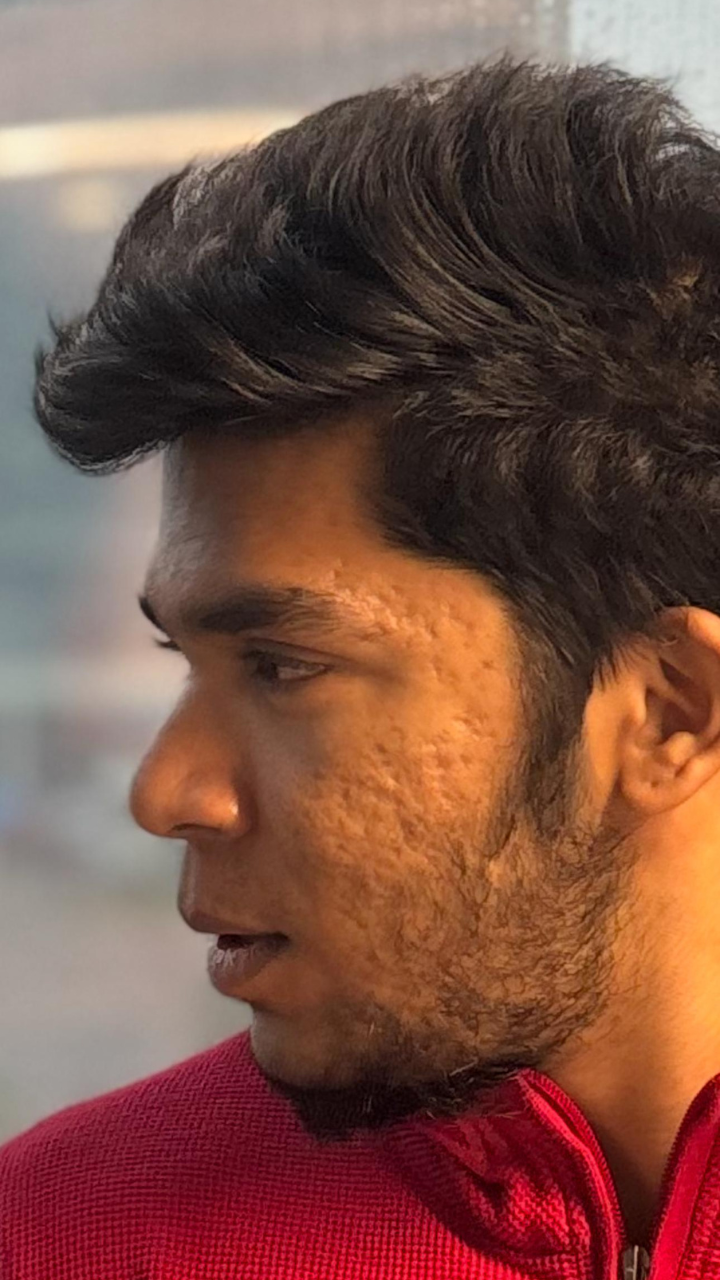
The patient presented with moderate post-acne scarring characterised predominantly by box scars — a subtype of atrophic acne scar defined by their sharp, well-demarcated edges and flat or depressed bases. Unlike rolling scars, which have a wave-like surface, or ice-pick scars, which are narrow and deep, box scars are wide, geometric depressions that cast visible shadows on the skin surface, making them particularly conspicuous in natural and artificial light. In this patient’s case, the scarring was distributed across both cheeks, a pattern typical of severe comedonal and inflammatory acne that had since resolved but left behind a permanently altered skin architecture. The depressions were created by fibrous bands of scar tissue tethering the skin surface down to deeper dermal layers — a structural problem that topical treatments and skincare alone cannot address.
Acne scars carry a weight that is difficult to fully appreciate from the outside. For Sachin, a 27-year-old working professional, the scars on his cheeks had been a daily presence for several years — long after the acne itself had cleared. Every professional setting, every photograph, every social interaction carried a quiet awareness of skin that looked damaged. Acne scarring at this level is known to affect self-confidence in ways that mirror the psychological impact of the original acne: patients describe a persistent feeling of being judged by something they had no control over. By the time he came to Redefine, Hyderabad, Sachin had a clear and grounded goal — not perfection, but a meaningful improvement in texture and a face he felt comfortable presenting to the world.
CONSULTATION & TREATMENT PLAN
WHAT WAS ASSESSED DURING THE CONSULTATION
Dr. Harikiran Chekuri conducted a detailed scar assessment and treatment planning session before proceeding:
- Scar subtype classification — confirmed box scars as the predominant type; rolling and ice-pick components noted and considered
- Scar depth and density — degree of fibrous tethering assessed by palpation and visual inspection under oblique lighting
- Skin thickness and quality — important for determining cannula approach and filler volume
- Distribution mapping — bilateral cheek involvement plotted to plan systematic subcision and filler placement
- Active acne status — confirmed absence of active inflammation before proceeding; active acne is a contraindication to subcision
- Patient’s expectations and goals — clearly seeking visible reduction in scar depth and a smoother skin surface
- Medical fitness and history of keloid or hypertrophic scarring reviewed
WHY SUBCISION WITH HA FILLING WAS CHOSEN
- Subcision is specifically designed to address the root cause of depressed scars — the fibrous bands that tether the skin downward. No other technique directly releases these bands
- Combining subcision with hyaluronic acid filling provides dual benefit: the release creates space, and the HA filler fills that space to maintain lift and prevent re-tethering
- HA fillers are biocompatible, reversible, and have a well-established safety record for intradermal and subdermal placement
- For box scars specifically, the sharp edges benefit most from subcision — which undermines the depressed floor and allows the skin to re-drape at a higher, more even level
- This combination approach offers visible improvement with minimal downtime compared to ablative laser or surgical excision options
PRE- & POST-OPERATIVE PHOTOS
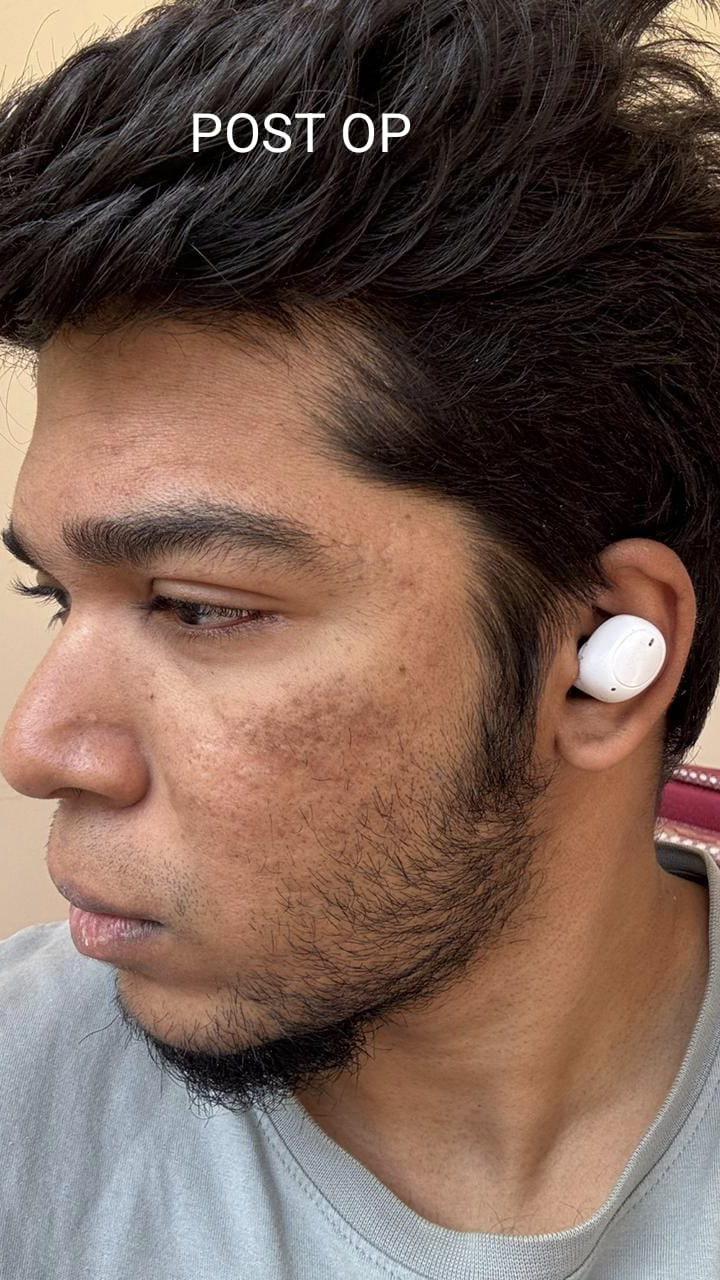
The images show the patient before (pre-op) and after (post-op) subcision with hyaluronic acid filling. The pre-operative image clearly demonstrates the depth and distribution of box scarring across the cheek. The post-operative image shows a marked reduction in scar visibility and improved skin surface texture at follow-up.
PROCEDURE DETAILS
STEP-BY-STEP OVERVIEW
- Pre-procedure assessment completed — scar zones mapped with oblique lighting and marked for treatment
- Topical anesthetic applied to treatment area and allowed to take effect — approximately 30–45 minutes
- Subcision performed — a fine hypodermic needle or blunt cannula inserted through a small puncture adjacent to each scar depression
- Fibrous bands tethering the scar base to deeper tissue severed by sweeping the needle/cannula in a fan-like motion beneath the scar floor
- Subcision repeated across all mapped box scar depressions bilaterally
- Hyaluronic acid filler injected into the subcised planes — small aliquots placed to maintain the released space and provide structural support to the skin surface
- Tissue massage performed immediately post-injection to distribute filler evenly and smooth any irregularities
- Result assessed under lighting — patient reviewed and discharged with care instructions
PROCEDURE FACTS
POST-OPERATIVE RESULTS
The follow-up assessment demonstrated a clear and satisfying improvement in the patient’s skin surface. The box scars, previously well-defined depressions that cast visible shadows across both cheeks, were significantly reduced in depth. The skin surface appeared markedly smoother, with the sharp scar edges softened and the tethered depressions lifted toward the surrounding skin level. The improvement was most noticeable in lateral lighting, where the surface irregularity was previously most visible. The patient noted the change himself, describing his skin as smoother than he had expected — a sentiment that reflects both the effectiveness of the technique and the accuracy of Dr. Harikiran Chekuri’s treatment planning.
OUTCOMES AT A GLANCE
PATIENT FEEDBACK
“ I’m honestly thrilled with the results. My acne scars have reduced a lot, and my skin looks much smoother than I ever expected. The procedure was well explained, recovery was quick, and seeing this kind of improvement has really boosted my confidence. ”
- Profile: Male · 27 years · Working Professional · Hyderabad
- Procedure: Subcision with Hyaluronic Acid Filling · Redefine, Gachibowli, Hyderabad · January 2026
- Surgeon: Dr. Harikiran Chekuri · Redefine
POST-PROCEDURE CARE & RECOVERY
INSTRUCTIONS GIVEN TO PATIENT
- Prescribed analgesics for mild post-procedure discomfort — typically paracetamol or ibuprofen as needed
- Gentle tissue massage of treated areas for 5–10 minutes twice daily — promotes even filler distribution and prevents localized firmness
- Avoid pressure on treated areas for 48–72 hours — no vigorous facial massage or manipulation
- Avoid active sun exposure for 2 weeks — use SPF 30+ sunscreen daily
- No active cosmetic products (retinoids, AHAs, BHAs) on treated areas for 1 week post-procedure
- Keep skin clean and moisturized — gentle cleanser and non-comedogenic moisturizer
- Follow-up appointment at Week 2 and Month 1 to assess scar improvement and discuss whether a repeat session is needed