

Low-level laser therapy stimulates follicles in early to moderate androgenetic alopecia and reduces shedding in some cases of telogen effluvium. This post covers the evidence, who it works for, what it cannot do, and how it fits alongside other treatments.
Low-level laser therapy for hair loss is not a fringe treatment. It is FDA-cleared, has a reasonable evidence base, and is used in clinics and at home by a significant number of patients worldwide. It is also not a standalone solution for advanced hair loss, and it is frequently oversold to patients who would be better served by a different treatment entirely. What it does, who it helps, and where it sits in a broader plan that is the honest version of this conversation.
According to Dr. Harikiran Chekuri, hair transplant surgeon in Hyderabad “Laser light therapy for hair loss works within a specific window. Early to moderate androgenetic alopecia,when follicles are still active and treatment is used consistently. Outside this window, the evidence thins out considerably. It is a useful tool in the right hands for the right patient not a replacement for a clinical assessment of what is actually driving the loss.”
What Is Laser Light Therapy and What Does It Do to Hair Follicles?
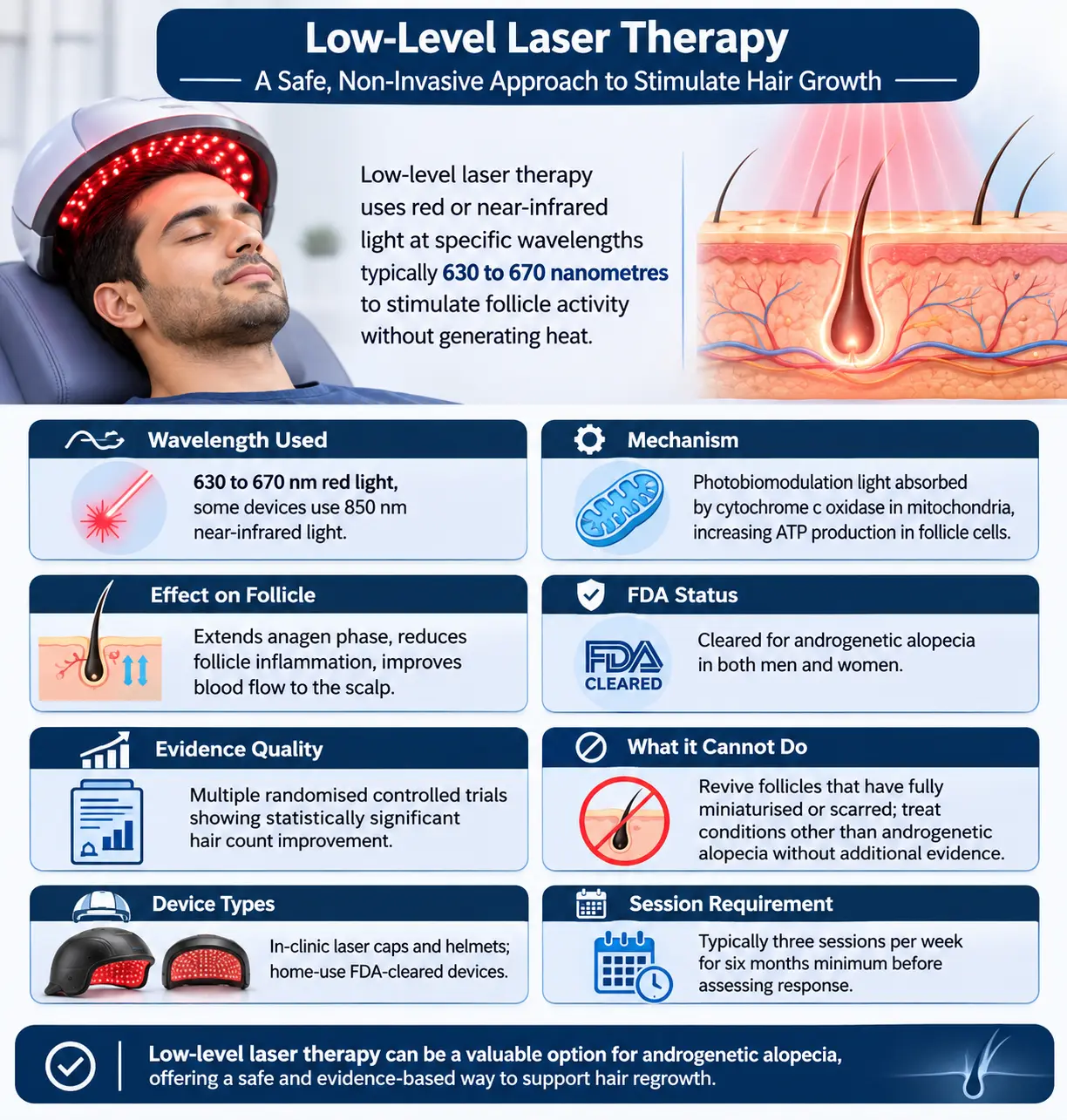
Robotic hair transplant and laser light therapy are frequently combined both target follicle activity through different mechanisms and the combination produces additive results in some patients.
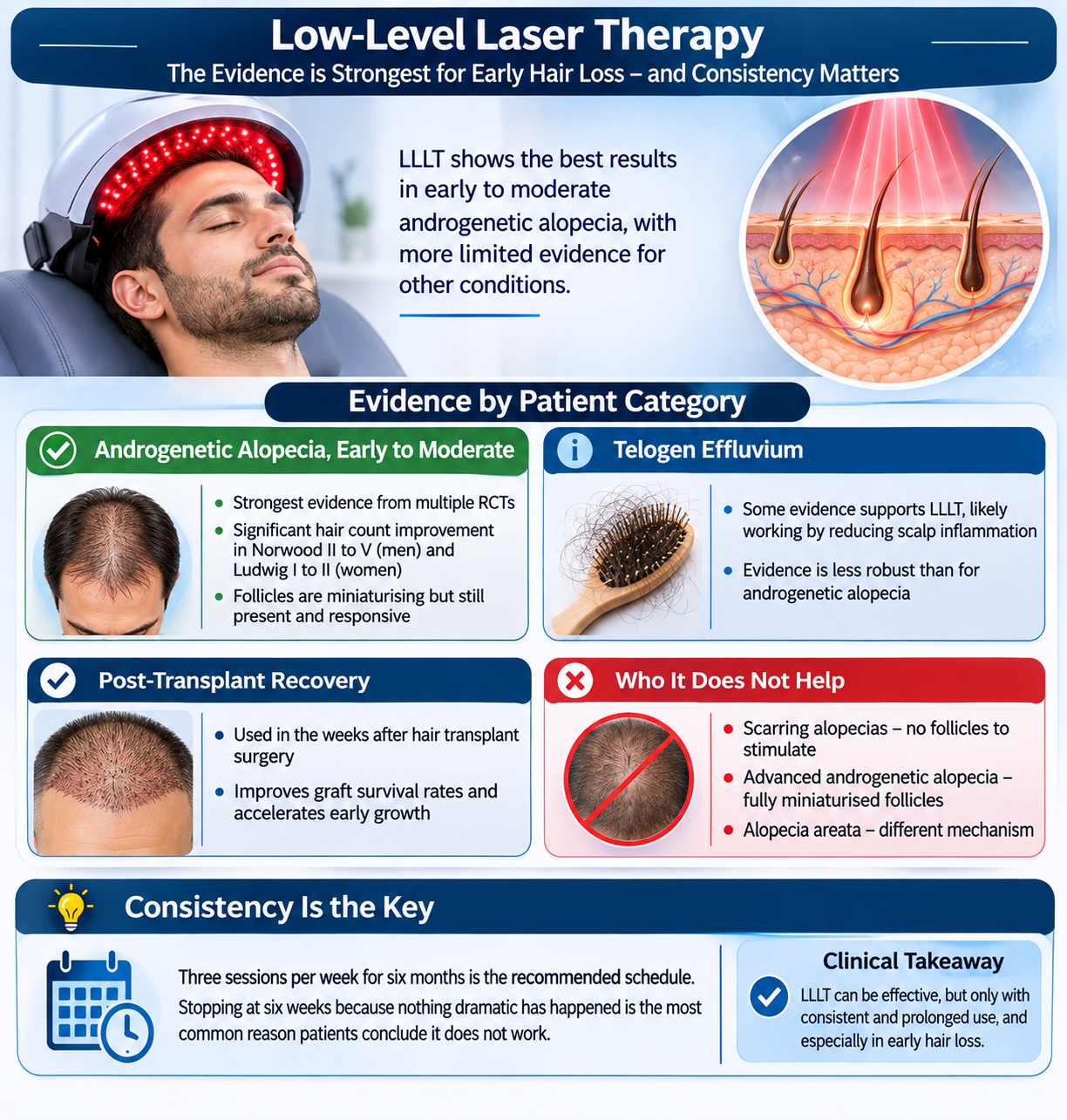
Who Does Laser Light Therapy Actually Help?
For patients whose hair loss has progressed past the stage where laser light therapy is likely to produce meaningful results, the post on why patients get rejected for hair transplant explains the surgical assessment criteria.
What Determines the Right Treatment Approach?
Laser light therapy works within a specific window. Outside it, the same time and money applied to a different treatment produces a better result.
- Stage of loss: Early to moderate androgenetic alopecia with follicles still active responds advanced loss with fully miniaturised follicles does not; trichoscopy confirms which stage a patient is at before any treatment is recommended
- Cause of loss: Androgenetic alopecia is the primary evidence-based indication; telogen effluvium has some supporting data; scarring alopecias, alopecia areata, and nutritional deficiency-driven loss each have different mechanisms that laser light therapy does not address
- Combination sequencing: Used alone the results are modest; combined with minoxidil, DHT blockers, or PRP the additive effect on follicle activity is clinically meaningful the right combination depends on what stage of loss the patient is managing and what they have already tried
- Maintenance vs active treatment: A patient in the early stages managing ongoing loss uses laser light therapy differently from a patient three months post-transplant trying to improve graft survival the same device, different clinical purpose, different session frequency and duration
A trichoscopy and blood panel together confirm the cause, stage, and what active follicles remain. That assessment is what determines whether laser light therapy belongs in the plan at all and it’s the same diagnostic foundation required before any robotic hair transplant decision is made.
Frequently Asked Questions
Is laser light therapy for hair loss evidence-based?
Yes. Multiple randomised controlled trials show statistically significant improvement in hair count in patients with androgenetic alopecia. It is FDA-cleared for this indication in both men and women.
How long before laser light therapy shows results?
Three to six months of consistent use three sessions per week before meaningful change is visible. Full response assessment at twelve months.
Can laser light therapy reverse baldness?
No. It stimulates follicles that are still active but miniaturising. Follicles that have fully miniaturised or produced scar tissue do not respond.
Does laser light therapy have side effects?
Minimal. Mild scalp warmth or tingling during sessions is occasionally reported. No systemic side effects. One of the lowest-risk interventions available for hair loss.
Can laser light therapy be used after a hair transplant?
Yes. Post-transplant laser light therapy is a supported application that improves graft survival and accelerates early regrowth when started in the weeks following surgery.
Reference
- Avci P, et al. Low-Level Laser (Light) Therapy (LLLT) for Treatment of Hair Loss. Lasers in Surgery and Medicine. 2014. https://pmc.ncbi.nlm.nih.gov/articles/PMC3944668/
- Hamblin MR, et al. Low-level laser therapy and hair regrowth: an evidence-based review. Lasers in Medical Science. 2016. https://pubmed.ncbi.nlm.nih.gov/26690359/
- Gupta AK, et al. Low-level laser therapy for the treatment of androgenic alopecia: a review. Lasers in Medical Science. 2018. https://pubmed.ncbi.nlm.nih.gov/29270707/